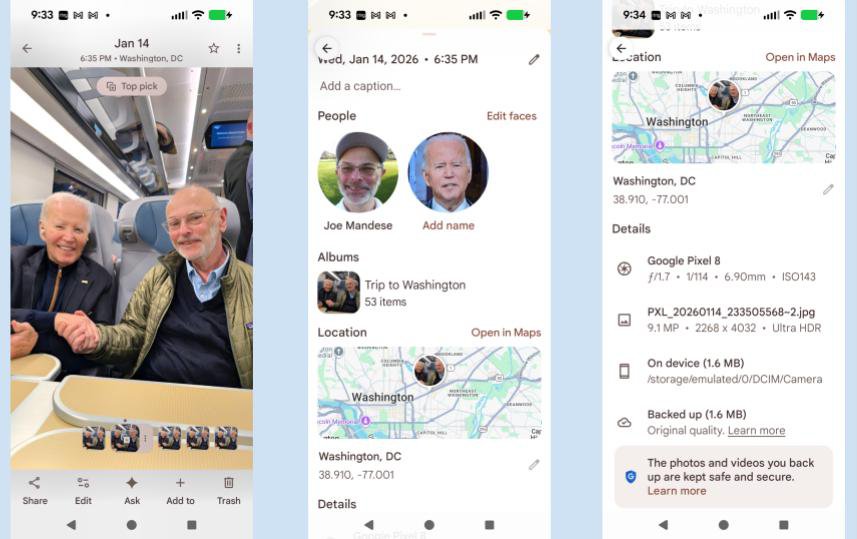
This post begins with me sitting on Amtrak Wednesday evening,
heading south along the northeast corridor to Washington, D.C. for MediaPost's Marketing Politics conference on Thursday (more on that later).
I had a reserved seat, but all the seats around
me were oddly empty, even though the rest of the train was packed. Until we stopped in Delaware and I was suddenly surrounded by men in dark blue suits with telltale earpieces in their ears. And then
Joe Biden sat down next to me.
I'll spare you the details about the rest of the ride (it's classified), but I did ask the Secret Service if they could take a photo of us, and the image you see
above is one of five the agent across from us took on my phone.
The problem is what happened when I posted it in my personal social media and shared the anecdote above. Some of my friends and
families ribbed me that it was AI-generated. I told them it was legit, but I know at least one -- maybe more -- didn't buy it, because a) it's pretty remarkable that it actually happened, and b) I
have a history of generating artificial images (see the headline on this column).
advertisement
advertisement
But here's the thing. All images created by people -- regardless of the technology used to generate them --
are, in effect, artificial.
I learned this when I was in college studying journalism in the late 70s and minored in photography.
A lot of people think old-school film photography
captures an authentic image, but there are many tricks to even analogue media that can alter, distort and/or create an artificial version of the subject being photographed. The photographer can do
many things with the camera altering exposure, lighting, perspective and cropping that create illusions and distortions.
Even after the image is captured on film, there are things
photographers do in a dark room while printing the image -- mainly dodging and burning parts of the printed image with more or less light to bring out or suppress parts of the image, solarizing it,
etc. that can alter and change the final printed image. In the olden days, before color photography, prints were also hand-colored to provide that effect.
In fact, the only version of
film-based photography that could arguably be called an unaltered image probably was a Polaroid instant image, but even that could be messed with.
I'm pointing this out because many people
think synthetic media began with digital photography, and digital image tech like PhotoShop, etc. But the truth is, every image generated by people is just some version of reality they want others to
see.
As some of you may already know, I'm a frustrated comics artist, because I cannot draw, and I have increasingly been using technology to augment that by using things like PhotoShop and
more recently LLMs to help me generate images I couldn't otherwise do on my own.
In fact, I use LLMs to generate images to illustrate MediaPost articles all the time now, but in almost every
case, I give credit where credit is due -- sourcing the LLM and describing the prompt.
I think that is the right way to handle AI, or any reality-altering technology in journalism. But I don't
do that in the comics I post on my personal blog, because they are not intended to be "reality" and readers should know that. In fact, most of my comics are labeled "Fake News," in case you missed the
point.
Anyway, my point is that if you cry -- er, I mean prompt -- wolf enough times, some people aren't going to believe you when you are talking about a genuine wolf, or a former President
sitting next to you on Amtrak.
In one case, I actually shared the photo log on my Android phone's camera, including the meta data included in the "About" image as proof to one particularly
skeptical friend.
Even my own daughter asked me if it was AI-generated at first.
It wasn't, but the fact that people who should trust me initially did not says something about the
nature of the world we are moving into, where people have to question every image, video, audio or written post they see or hear.
That came up a lot during our Marketing Politics conference on
Friday, and I'll come back on that when I get time to write a wrap-up of it soon.
For now, I'll leave you with one unclassified quote Biden did give me to share with you.
When he asked
me what I was doing in D.C., I told him I was emceeing a conference on political marketing, and he immediately replied, "Marketers are good people." I took that to be authentic.