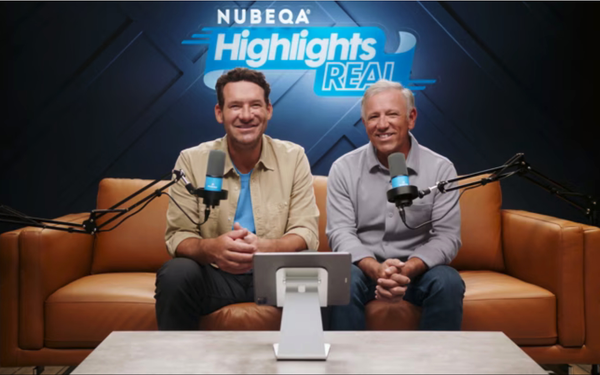
A month after teaming with former NFL
quarterback Tony Romo to market its prostate cancer drug Nubeqa, Bayer has sued Johnson & Johnson (J&J’s) for false advertising of that firm’s rival drug Erleada.
Romo
appears with his prostate cancer survivor father in Nubeqa’s Highlights Real campaign, in which they provide play-by-play
commentary on the activity of other prostate cancer patients.
In its lawsuit, filed in the U.S. District Court for the Southern District of New York, Bayer cites J&J’s “false
advertising campaign” as consisting of a press release, issued a few days after the Romo campaign began, plus “two presentations made available on its Medical Connect
website.”
The suit, which alleges that J&J made “false claims regarding the efficacy of Nubeqa…in an effort to increase its market share in a concentrated and
increasingly competitive prostate cancer treatment market,” seeks preliminary and permanent injunctions against J&J in addition to damages.
advertisement
advertisement
"Litigation does not change data,"
J&J told Reuters in a statement. "Our analysis was designed to meet rigorous guidance on real-world evidence, and this legal action demonstrates Bayer’s obvious misunderstanding of
methodological frameworks and real-world evidence principles."
Bayer has been counting on Nubeqa as a key driver of the resurgence of its pharmaceutical business.
“With
Nubeqa…we may have the largest product ever in the history of our company,” pharma division president Stefan Oelrich told the J.P. Morgan Healthcare Conference last month, stating that
the drug was “poised to become the number one product in prostate cancer.”
Another competitor in the field for advanced prostate cancer is Xtandi, a joint product of Pfizer and
Astellas.
In another legal development concerning cancer, Bayer last week offered $7.25 billion to settle a decade-old case over claims that the weedkiller Roundup, which it had taken on in
its Monsanto merger, causes the disease.
The move comes on the heels of the U.S. Department of Justice in December urging the Supreme Court to erase billions of dollars in Roundup liabilities,
as well as the Environmental Protection Agency last February approving another Bayer herbicide, dicamba, that had previously been blocked by federal courts, according to a U.S. Right to Know. That report details numerous instances of former Bayer lobbyists now
working for the Trump Administration.