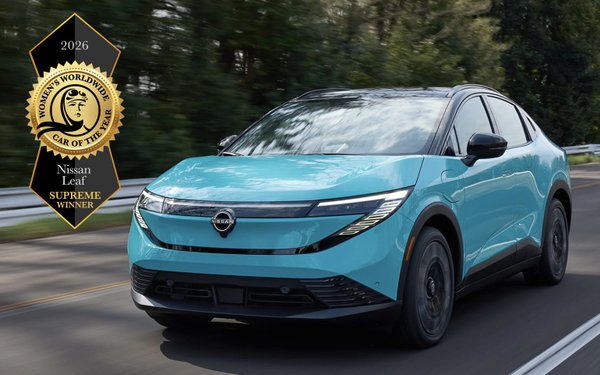
The economical and design-forward 2026 Nissan Leaf has
been chosen as the 2026 Supreme Winner by the Women’s Worldwide Car of the Year jury.
I’m one of 86 women journalists from 55 countries across five continents who
cast their vote after months of testing, analysis and debate.
The unique award aims to recognize the best cars of the year and to give a voice to women in the automotive
world. The voting criteria are based on the same principles that guide any driver when choosing a car. The jurors do not select a “woman’s car,” because cars are not
gender-specific.
This year, it was an especially tough decision — all five vehicle category winners were quite good. The Leaf, the winner in the compact car category, beat out
the Mercedes-Benz CLA (large car), Hyundai Ioniq 9 (large SUV), Toyota 4Runner (4x4), Skoda Elroq (compact SUV) and Lamborghini Temerario (performance car).
advertisement
advertisement
I had two separate
opportunities to test drive the Leaf last fall. My first drive last September was only for a few hours at Nissan’s Technical Center in Farmington Hills, Michigan.
I was
immediately impressed with the quality of the finishes and the upscale appearance, all for a vehicle with an MSRP starting at $29,990 (before destination fees). It’s notable that the new Leaf is
actually cheaper than the original 2011 model, which started at $32,780.
A few months later, I had the Leaf as my daily driver for a week. I had hoped to take it to a tailgate
at Michigan State and use the very cool vehicle-to-load (V2L) capabilities that turns electric vehicles into mobile power banks. But alas, the weather that weekend was too cool and the tailgate
because an indoor affair.
Had we stayed outside, I could have used the Leaf to power a TV and a barbecue grill without swiping significant power from the battery. Now
that’s a pretty cool party trick.
The new model feels significantly more premium than its price suggests.
It offers 303 miles of range on a full charge and
a NACS (Tesla) port, which means easier to find charging stations.
It compares favorite to its EV competitors, the Hyundai Kona and Kia Niro, which have less range — 261
miles and 253 miles, respectively. Neither offers Google built-in, a dimmable moonroof, a wide angle front camera view or stylish flush door handles.
“In our voting, we
have focused on vehicles that stand out not only for their figures or technology, but for how effectively they respond to people’s real, everyday needs,” according to Marta García,
executive president of WWCOTY. “The Nissan Leaf represents a mature and intelligent vision of electrification — one that makes electric mobility truly usable and accessible.”
The Nissan Leaf convinced the jury with its coherent and realistic approach to electric mobility. It stands out for its practical approach, offering smooth, quiet driving and outstanding
efficiency, particularly in urban and suburban environments. Its architecture prioritizes interior space and ease of use over complex solutions, delivering one of the most intuitive electric driving
experiences on the market.
The final decision reflects the broader transformation of the automotive sector, where electrification, sustainability and user-centered design have
become fundamental pillars. The strong competition in this year’s awards demonstrates how manufacturers worldwide are raising standards across all segments.