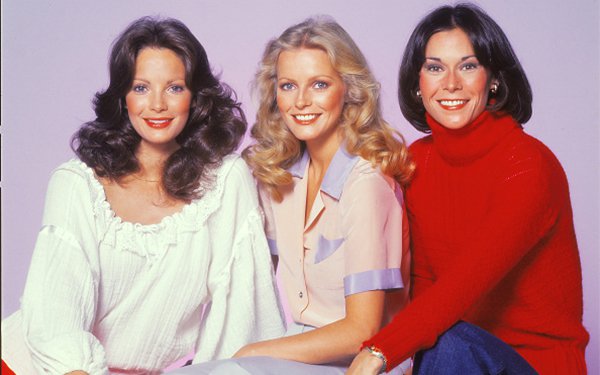
A commemoration this
spring marking the 50th anniversary of the premiere of “Charlie’s Angels” will position the show as “a landmark moment in television” that redefined “the role of
women in prime-time entertainment.”
Anyone reading this TV Blog who is familiar with the show is asked to hold their laughter for a moment.
“The series broke the mold by placing three formidable private investigators at the center of their own high-stakes narratives. This shift challenged industry
norms and empowered generations of viewers,” gushes the Paley Center for Media, which plans to honor three of the surviving stars of the show at its annual gala in New York in May.
All are welcome to now burst out laughing at these side-splitting assertions. The one I like best: The idea that “Charlie’s Angels” empowered
generations of viewers.
advertisement
advertisement
Empowered them how, and to do what? The press release from Paley doesn’t say. Perhaps they were at a loss for words on this
particular issue.
Located in midtown Manhattan, the Paley Center was founded 50 years ago by William S. Paley. The Center describes itself as “an
organization dedicated to preserving media history.”
In its press material, the Center also notes that
its building on West 52nd Street has been named “Best Children’s Party Place” three years in a row, although it does not specify by whom.
The producer of “Charlie’s Angels” was Aaron Spelling, who reigned as one of the kings of television from the 1970s to the 2000s.
He made dozens upon dozens of TV shows, many of them stinkers. But he made plenty that defined their eras.
In addition to “Charlie’s
Angels,” Spelling’s productions included “Dynasty,” “The Love Boat,” “Fantasy Island,” “Hart to Hart,” “Matt Houston,”
“T.J. Hooker,” “The Colbys,” “Melrose Place,” “Beverly Hills 90210,” “Charmed” and “7th Heaven.”
I never knew the man, but based on what I think I know of him, it is doubtful that feminism and empowerment were on Aaron Spelling’s mind when he made “Charlie’s
Angels.” He was a showman, not an activist.
“Charlie’s Angels” premiered in
September 1976 and lasted until spring 1981. It is one of the best-remembered TV shows of its era, not least because its female stars were beautiful, alluring and glamorous.
Farrah Fawcett became a superstar on the show, even though she left after the first season. Her famous poster in a one-piece bathing suit, which graced the bedroom walls of
a million teenage boys, was a cultural touchstone if there ever was one.
Hers was the most successful of the “Charlie’s Angels” pinup
posters, but they all had them.
We caught an old Johnny Carson show from the late ’70s last weekend on
Antenna TV (where it airs nightly) on which guest Cheryl Ladd, who replaced Farrah Fawcett in Season Two, unveiled her own poster, which Johnny appreciated very much.
In the “Charlie’s Angels” era, critics and observers of the TV business referred to shows like “Charlie’s Angels” as “jiggle” television.
That sounds less like feminism and more like objectification.
“It used to be that when the set jiggled, you called the repairman,” producer Garry
Marshall once said. “Now, when it doesn’t jiggle, you turn it off.”
The assertion that “Charlie’s Angels” redefined the
role of women in prime-time entertainment is debatable.
All you have to do is look at the prime-time network
schedules for the seasons when “Charlie’s Angels” was on ABC and you find show after show with female lead characters.
They included:
“Rhoda,” “Phyllis,” “Maude,” “Laverne and Shirley,” “One Day at a Time,” “Alice,” “Police Woman,” “The Betty
White Show,” “The New Adventures of Wonder Woman,” “The Bionic Woman” and the little-remembered “On Our Own,” a comedy about an ad agency run primarily by
women.
This spring’s salute is shaping up as a rare reunion of the three most famous surviving “Angels” who will each receive the
prestigious Paley Honors Award May 14 at the Plaza Hotel -- Cheryl Ladd, 74, Kate Jackson, 77, and Jaclyn Smith, 80. Sadly, Fawcett died of cancer in 2009 at age 62.