Kohl’s management team may
be new, but the results are all too familiar: Kohl’s says sales are still falling, with fourth-quarter revenue decreasing 3.9% to $5 billion. And comparable sales slipped 2.8%, both worse than
forecast, after executives had hoped to at least stabilize the company's years-long decline.
There is some good news, however. Profit margins strengthened as efficiency moves began to pay off,
with net income rising to $125 million, compared to $48 million in the year-ago period.
Michael Bender, named permanent CEO in November after serving in an interim capacity since last May,
struck a cautiously optimistic tone. "We are ending 2025 in a stronger position than we started, with important work still ahead of us," he said, adding that the company "made meaningful progress" in
managing costs, delivering improved earnings and generating cash flow despite a softer-than-expected fourth quarter.
advertisement
advertisement
For 2026, Bender is forecasting sales somewhere between down 2% and flat
— hardly a ringing endorsement, but a signal that the freefall may be nearing a floor.
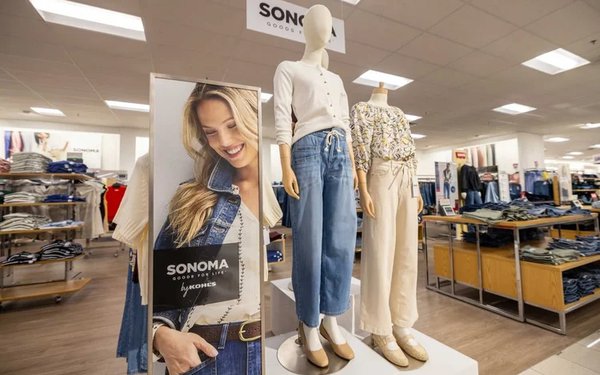
Kohl's, based in Menomonee Falls, Wisconsin, is betting that an expanded private-label offering
— more affordable, owned apparel brands mixed in with national labels — will help win back core customers.
But executional fixes can only go so far. The department store format is
struggling across all price points as consumers migrate toward specialty retailers and online shopping. For moderate-price players like Kohl's and JCPenney, the headwinds are even stiffer, as shoppers
juggle family budgets against rising food and energy costs.
David Swartz, the Morningstar analyst who follows the company, acknowledges the progress but isn't ready to call it a comeback.
"Although there are signs of progress," he writes, "a retailer with falling sales cannot be classified as healthy." Still, Swartz thinks observers are underrating Kohl's resilience. The chain has real
assets, including more than 30 million loyalty members, freestanding off-mall locations less vulnerable to foot-traffic declines, and a growing stable of proprietary brands: "We think investors
underestimate the benefits of its marketing, merchandising, and operational efforts."