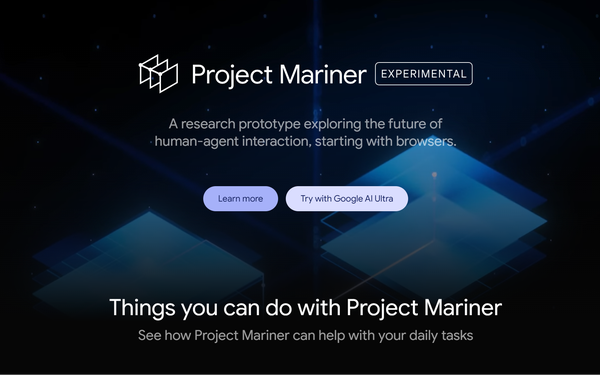
Google’s quest to create a universal assistant could have
been the reason the company reportedly restructured the team behind Project Mariner, a research prototype browser extension from Google DeepMind and artificial intelligence (AI) agent for the Chrome
browser that understands multimodal inputs.
Companies like Perplexity have been releasing their versions of browser agents. This week, Perplexity released its Comet for iOS browser, with
Google as the search engine supporting the app.
Matthew Prince, CEO of Cloudflare, predicts that AI bot online traffic will exceed human traffic by 2027, Shelly Palmer, professor of advanced
media, reported on Friday. Palmer said, citing Prince, that before generative AI, the web was only
20% bot traffic -- a category that Google's crawler dominated. Cloudflare powers about 20% of all websites.
advertisement
advertisement
It’s easy to see how this change will require advertisers to think in new ways
and tech companies develop new infrastructure. SEO and paid media strategies designed for human behavior will not apply.
Project Mariner and OpenClaw represent two
different approaches to agentic AI that can autonomously perform tasks on a computer rather than just generating text.
This is a Silicon Valley trend. Google intends to integrate developed
computer-use capabilities into its long-term AI initiatives.
This is likely why some of the Google Labs staff working on Project Mariner, the research prototype, have moved on to
higher-priority projects, according to two people familiar with the matter, Wired reported.
It also appears that the broader industry has shifted toward agent systems like OpenClaw, and command-line tools like Claude Code, while browser agents struggle. For example, OpenAI walked away from its browser-based "ChatGPT Agent."
Meta Platforms in March acquired Moltbook, which has ties to Peter Steinberger, who created the OpenClaw framework that launched in late 2025. Moltbook, a social media platform for AI agents,
Cofounded by Matt Schlicht and Ben Parr, Moltbook was built using OpenClaw, which in February became an open-source project supported by OpenAI.
Google confirmed the changes but
stressed that the expertise developed will feed into other products, including the Gemini Agent announced last year, according to decoder.
OpenClaw is considered a major competitor to corporate-led agents,
but it also, according to some, have security flaws, which Google would not accept.