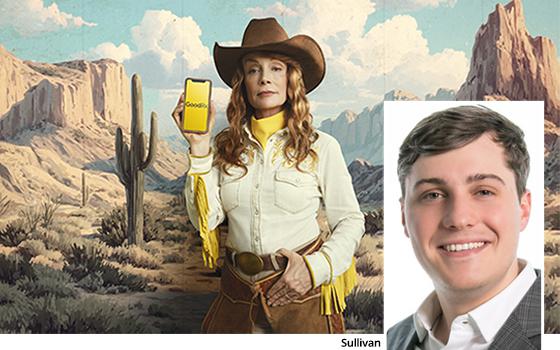
Ryan Sullivan shared how
GoodRx’s “fearless ally” brand strategy led to the Savings Wrangler campaign, covering character-driven storytelling, full-funnel channel strategy, and balancing
entertainment with clear communication of prescription savings.
What strategic insight led to leaning into
more character-driven storytelling on the Savings Wrangler campaign?
This really came out of a larger piece of brand strategy work we did to define the
role GoodRx should play in the market. We developed a brand blueprint around the idea of being a “fearless ally” for consumers navigating prescription costs.
When you look at the category, most healthcare marketing is very clinical and transactional. It focuses on explaining the product rather than creating a relationship with the consumer.
We saw an opportunity to take a different approach and build a brand that feels like it is actually on the consumer’s side.
advertisement
advertisement
Once we had that strategic foundation,
the creative direction followed pretty naturally. If your brand is a fearless ally, you need a way to bring that role to life. The Savings Wrangler became the embodiment of that idea. She represents
GoodRx stepping in to help people tame the Wild West of prescription pricing.
The goal was not just to launch a campaign. It was to establish a distinctive brand
platform that people can recognize, remember, and come back to when they need help navigating the prescription experience.
The campaign flips the conventional healthcare playbook to stand out in a crowded and often low-trust environment. How did you ensure the creative remained entertaining
while still clearly communicating the core value of prescription savings?
Striking that balance was critical for us. Humor can be a powerful tool, but
healthcare is a space where trust and credibility matter deeply. Our goal was not humor for humor’s sake. It was to use wit and storytelling to make the experience more approachable while
keeping the core value clear.
When we looked at the category, we also saw clear white space. Most healthcare advertising is very serious and clinical, which makes a lot
of it feel interchangeable. We believed there was an opportunity to introduce humor in a thoughtful way to help the work stand out and be more memorable.
We anchored the
entire campaign around a simple metaphor: prescription pricing often feels like the Wild West. It can be unpredictable, confusing, and frustrating. The Savings Wrangler exists to tame that chaos and
help people get the savings they deserve.
Creatively, that meant letting the character and world-building capture attention while the message stayed straightforward.
GoodRx helps you save time and money on prescriptions. When the entertainment works in service of the idea instead of replacing it, it becomes a way to make a serious problem feel more solvable rather
than trivialized.
The rollout spanned a full-funnel effort. How did the role of each channel play in
moving consumers from awareness to action when most people aren’t actively shopping for prescriptions?
One of the realities of our category is that
people are not actively shopping for prescription savings every day. The need appears when a doctor writes a prescription or when someone arrives at the pharmacy counter. That creates a behavior
challenge because many people simply go to their pharmacy without considering that they could compare prices or explore other payment options.
With the Savings Wrangler
campaign, we intentionally used one of our most expansive channel mixes to date to increase the surface area for brand discovery. The campaign appeared across TV, streaming, radio, programmatic,
display, social, CRM, web integrations, and earned media. It also included a sponsored Good Morning America segment and an immersive Times Square subway station takeover. These high reach channels
helped introduce the Savings Wrangler and build broad awareness of the GoodRx brand.
At the same time, we layered in lower funnel tactics across digital channels to
reach people who were already seeking savings solutions or were likely to need them soon. Those touchpoints reinforced how GoodRx works and made it easy for consumers to take action when the moment of
need appeared.
Successful campaigns work across multiple funnel stages at once. By diversifying our tactics, we were able to meet people wherever they were in their
journey and make checking GoodRx feel like a natural step when a prescription need arises.
For
marketers in similarly complex or low-interest categories, what guidance would you offer on making their brand feel emotionally engaging rather than purely functional?
One of the biggest mistakes marketers make in complex categories is assuming the product is the only story worth telling. In reality, most functional categories sit inside very human
moments in people’s lives.
Healthcare is a perfect example. Managing prescriptions is not just a transaction. It can involve stress, confusion, and the
responsibility of caring for family members. When you start with those human realities, the creative opportunities open up.
Another important discipline is resisting the
instinct to explain everything or confuse consumers with disjointed branding decisions. Many complex categories default to dense messaging and product features. While that information matters, it
often makes the work harder for people to engage with. Instead, focus on a simple, memorable idea that captures the role your brand plays in someone’s life.
For
us, that idea was being a fearless ally who helps people navigate the Wild West of prescription pricing. Once that role was clear, the creative could build emotion and personality around it while
still reinforcing the core value of saving time and money on prescriptions.
Ultimately, people connect with brands they understand, can recall, and trust will deliver on
the expectations you set in your marketing. If you can communicate that clearly, even brands in the most functional of categories can be salient.
Is there a brand or campaign you admire that you wish you’d worked on and why?
One
campaign I have always admired is the long running work Progressive has done with Flo. It is a great example of the power of committing to a distinctive brand platform and building it over
time.
What makes that campaign so effective is the consistency. They introduced a memorable character, established a clear brand voice, and then continued evolving the
work without losing the core idea. Over the years it has created strong brand recognition and a real sense of personality in a category that can otherwise feel very transactional.
They’ve also done a great job of introducing new brand elements without tearing down the distinctive elements that they’ve spent incredible sums of money to establish.
Everything from the colors, to the name tags, to the situations all seem to grow and evolve as part of a clear ecosystem that is easy to spot and know at a glance. That’s not easy.
As a marketer, that kind of long term creative discipline is something I really respect. It shows that when you invest in a strong platform and stay committed to it, you can build
something that keeps working for the brand year after year.
If you’re interested in submitting content for future editions, please reach out to our Managing Editor, Barbie
Romero at Barbie@MediaPost.com.