Editor's note: Developing story -- additional content added from an earlier version.
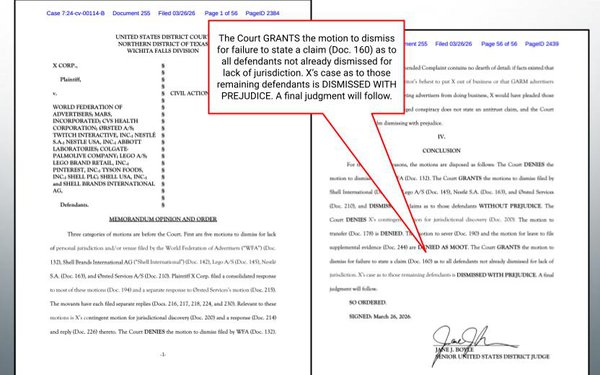
Siding against Elon Musk, a federal judge has dismissed X Corp's ad-boycott suit
against the World Federation of Advertisers and advertisers.
In a decision issued Thursday, U.S. District Court Judge Jane Boyle in the Northern District of Texas ruled
that X's allegations, even if proven true, wouldn't establish an antitrust claim.
"X has not stated an antitrust injury," Boyle wrote in a 56-page opinion.
The ruling came in a lawsuit brought by Musk's X Corp. in 2024,
when he alleged that the Belgian-based World Federation of Advertisers and its now defunct brand safety initiative, Global Alliance for Responsible Media (GARM), sparked a “massive advertiser
boycott” that cost the company billions in ad revenue.
advertisement
advertisement
Musk also sued advertisers -- energy companies Ørsted (based in Denmark) and Shell; food giants Mars,
Nestle and Tyson; healthcare company CVS; pharmaceutical firm Abbott; toothpaste and personal care brand Colgate-Palmolive; toy maker Lego; and social platform Pinterest -- for allegedly conspiring
with GARM to deprive X of ad dollars.
The complaint alleged that between November 2022 and December 2022, at least 18 GARM-members stopped advertising on Twitter, and that
“dozens” of other members “substantially reduced” their advertising.
Musk sued three weeks after the Republican-led House Judiciary Committee issued a report accusing GARM of coordinating
action by corporations, ad agencies and other industry groups in order to “demonetize platforms, podcasts, news outlets, and other content deemed disfavored by GARM and its members.”
That report specifically accused GARM of colluding to cut ad revenue to X after its October 2022 acquisition by Elon Musk.
The World Federation of
Advertisers shuttered GARM in August, days after Musk sued.
The trade organization has repeatedly said GARM's brand safety standards were voluntary, and that members were free to accept or reject those standards.
Last
year, the World Federation of Advertisers and brands urged Boyle
to throw out the case on several grounds -- including that they weren't subject to jurisdiction in the Texas district where Musk filed the case.
They also argued to Boyle that X's complaint lacked allegations that would show the companies colluded with each other, as opposed to making individual decisions about where to
advertise.
The complaint “is bereft of facts concerning specific persons who agreed to take some action, or a date, time, or place at which they did so,” they wrote in a motion
seeking dismissal.
Boyle dismissed claims against Orsted and some brands' international entities on jurisdictional grounds. Those dismissals were without prejudice, meaning Musk theoretically
could bring the claims again in a different forum.
But Boyle dismissed claims against the other defendants -- including the World Federation of Advertisers, U.S.-based companies and U.S.
divisions of the international companies -- on the merits and with prejudice, meaning Musk can't amend the allegations against those defendants and bring them again.
She wrote that even if the
World Federation of Advertisers and other defendants engaged in a "group boycott," the allegations in X's complaint against wouldn't warrant the conclusion that the companies violated antitrust
law.
Boyle gave two reasons for that part of the ruling. The first was X didn't allege that the defendants intended to boost one of X's rivals by engaging in the supposed boycott.
"X
has not alleged that the boycott against it allows or is intended to allow a competing social media company to corner the supply market for online advertising space," Boyle wrote.
She added
that even though X alleged that the boycott benefited Pinterest, X did not allege "that the advertisers chose to do business with Pinterest -- or any other social media company -- as part of an
agreement not to do business with X."
The other reason Boyle gave for her decision was that the defendants weren't alleged to have tried to stop others from advertising on X.
"The
conspiring advertisers here did not attempt to force X to advertise with only GARM advertisers so that they could control the social media advertising market or any other market," she wrote. "They
merely decided that they would not buy from X for their own advertising needs, notwithstanding if X sold advertising space to anyone else."