To mark International Family Day (May 15), let’s focus
on Ronald McDonald House, the 52-year-old nonprofit that provides crucial support to families with hospitalized children.
I knew that Ronald McDonald House takes care of lodging, meals and
transportation, but learned during a conversation with Chief Marketing and Communications Officer Joanna Sabato that the charity also provides psychosocial services like art therapy, peer support,
counseling and referrals, along with schooling for siblings, a community of shared experiences, and more.
To get that messaging across, Ronald McDonald House is eschewing
the celebrity spokesperson route so common with nonprofits these days, officially announcing a decidedly different approach this morning: the debut of the McBrides, a non-celebrity
spokesfamily.
Consisting of mom Jules, dad Jevon and daughter Juliana, now nine years old, the McBrides’ story began before Juliana was even born -- when a car accident severely
injured Jevon and 25-week-pregnant Jules. Born prematurely at just one pound, 11 ounces, the girl fought for survival while her father went through a series of surgeries and her mother needed a
wheelchair.
advertisement
advertisement
As Juliana underwent ongoing care and treatments in Kansas City – first at St. Luke’s Hospital and then at Children's Mercy Downtown -- her parents stayed in the
nearby Ronald McDonald House for 105 days during their ordeal.
The McBrides’ role as Ronald McDonald House spokesfamily actually began May 14, via a partnership with the syndicated “Jennifer Hudson Show.” Not only was the family featured in a 13-minute segment along with Ronald McDonald House CEO Katie Fitzgerald, but the charity became the first-ever nonprofit featured in the
program’s Spirit Tunnel," a backstage – often viral -- part of the show in which staff members cheer on guests as they walk to the stage.
In their
new capacity, which will last at least through the end of this year, the McBrides’ earned-media-centered activities will center on additional TV appearances, podcast appearances, and other media
interviews.
Their story will be amplified through social media, other owned channels, and brand partnerships, Sabato told me.
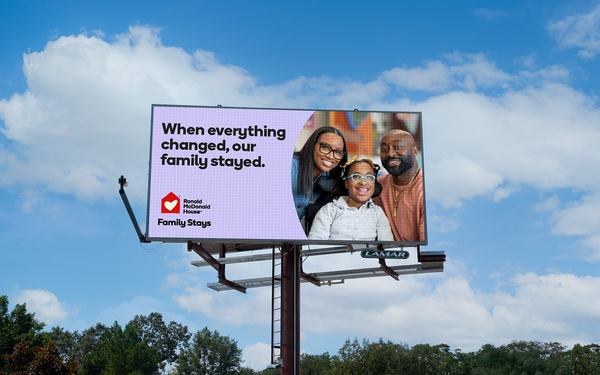
And starting May 15, the McBrides are featured in a
national digital out-of-home campaign under a new Ronald McDonald House pro bono partnership with Lamar Advertising, which said it will allocate more than $2 million in outdoor media over the next 12
months. The campaign creative comes from Omnicom’s TBWA\Chiat\Day Chicago.
(This marks Lamar’s fourth year of designating a pro bono nonprofit partner, with the previous
three being Dolly Parton’s Imagination Library, Boys & Girls Clubs of America, and Make-A-Wish).
With Ronald McDonald House touting its non-celebrity outreach approach, we asked
Sabato what’s become of the nonprofit’s original celebrity figure: Ronald McDonald himself. After all, the red-haired clown was nowhere to be found on the charity’s current website.
“He is part of the McDonald’s brand,” Sabato responded, “but not part of the Ronald McDonald House brand in
a mascot capacity. We really focus on the voices and stories we are sharing, like the McBrides, versus Ronald McDonald the clown.”
In any event, the organization last year decided to
consolidate all its local independently operated chapters (currently numbering 250 in over 60 countries) under the “Ronald McDonald House” name as part of what Sabato called a
“refreshed brand identity,” Previously, there had been various names and logos around the globe. “Ronald McDonald House’ replaced the previous name, “Ronald McDonald
House Charities.”
“One single verbal and visual identity,” Sabato noted, also makes it easier “to activate one global campaign strategy. It allows us to
sing as a chorus versus a bunch of individual soloists.”
Retention of “Ronald McDonald” in the name, meanwhile, allows the nonprofit “to honor our legacy with
McDonald’s and with McDonald’s customers,” Sabato said.
The fast-food chain, which was a founding partner, continues to be a major donor and to run co-branded
promotions.
But Ronald McDonald House can’t currently serve all the families needing its help, with local chapters at or near capacity.
The charity says it’s
only meeting the demand of 55% of such families in the U.S. and under one-third globally, so it’s set a goal of doubling the number of families it serves by 2030.
Getting such families
and others to know about what Ronald McDonald does is a key goal of the spokesfamily campaign, along with recruiting volunteers -- and, of course, raising money to fund those expansion efforts.
The spokesfamily campaign, Sabato said, serves to both “deepen connection to the people who already support us” and to “introduce Ronald McDonald House to a new generation”
who “resonate to authenticity. They want to understand the real experience, not just the organization.”
Now, by “putting a real family at the center of the story,”
Sabato explained that Ronald McDonald House is using “authentic storytelling that really reflects the impact of our work…When we hear directly from someone who has lived through it,
there’s a level of understanding and connection that you can’t replicate [otherwise].”
“The McBrides’ journey was unexpected, overwhelming and deeply
human,” she related. “It shows both the challenges families face and the role that Ronald McDonald House plays in helping them through it.”
To measure campaign success,
Sabato said that Ronald McDonald House will look at “more than just reach. One thing we’ll be looking to track is, are we shifting perception of who we are and what we do, and ultimately
driving donation intent.”
Over time, she added, we want to “make sure that people are volunteering, and are aware that we exist so that they can access the services when they need
them.”