AI has grown in popularity, with
many consumers reading AI summaries and not clicking through to the full email. But there are limits to that, and marketers seem to be lagging behind consumers in adopting AI, judging by a pair of new
studies from Validity.
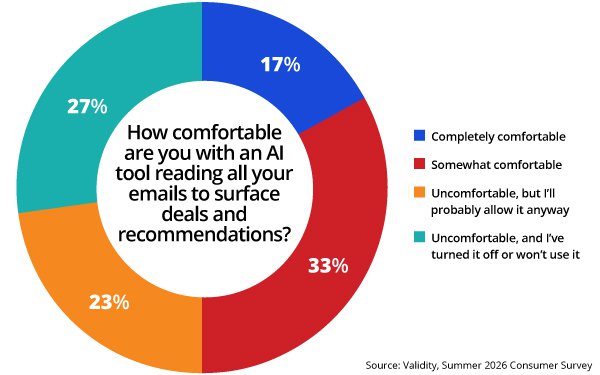
Of the consumers polled, half feel comfortable using an AI tool to read all their emails and half are uncomfortable to varying degrees.
But, as with
many things, it depends on age. Of the millennials surveyed, 22% have made a purchase without opening the message, with Gen Z just behind them. But only 1% of Boomers have done so.
Overall, 35% will read the summary and then open the full email. And 15% will read the summary and decide not to open the email, while 14% will skip the summary and open the email.
In
addition, 5% will delete the email based only on the summary while the same percentage will delete the email without reading the summary. The remaining 24% do not notice or pay attention to AI
summaries.
advertisement
advertisement
In general, only 17% of shoppers are completely comfortable with an AI tool reading all their emails to surface recommendations and deals. Another 33% are somewhat comfortable, and
23% are uncomfortable but will probably allow it. And 27% are uncomfortable and have turned off AI or won’t use it.
When asked how likely they are to use an AI assistant, 33% say
they are unlikely and would rather do their own research, and 8% say never. But 25% are somewhat likely to use an AI assistant, 20% are very likely to start and 15% are already on board.
What
are consumers worried about when it comes to AI? A fourth say misuse of their personal data is their top concern. And 40% would trust an email less if they knew it was written by AI.
On
the marketing side, brands face these challenges when trying to adopt AI:
- Team lacks skills to evaluate or deploy AI solutions—26.6%
- Poor data
quality undermines AI effectiveness—25.1%
- Difficulty proving ROI or measuring outcomes—23.2%
- Integration challenges with existing
systems—33.6%
- Budget constraints or unclear funding—21.4%
- Leadership doesn’t understand AI’s value—15.8%
- Vendor landscape is too confusing—7.4%
- No significant challenges—20.3%
Meanwhile, the marketers surveyed report their levels of AI
maturity as follows:
- Research & development—Building or training proprietary AI models, but not yet actively deployed in marketing workflows—19.9%
- Piloting—Testing AI tools with a limited scope--19.9%
- Exploring—Researching AI options or use cases, but haven’t started
pilots--17.5%
- Scaling—Expanding successful AI initiatives across marketing—13.8%
- Integrated—AI is embedded throughout marketing operations—11.7%
- Paused—Tried AI, but either the results didn’t meet expectations, costs were too high, lacked the right talent to manage, or another reason—3%
- No current AI
initiatives—14.3%
Meanwhile, 42.9% of marketers expect to increase their spending on email this year. However, email is second to paid social, at 45.7%. Other advances
are reported in SEO and GEO, including AI-powered search and discovery (38.7%), events (35.3%), influencer and creative partnerships (30,8%) and paid search (29%). Meanwhile, 27.7% are increasing
their spend on movile and SMS.
"Marketers and consumers are at an inflection point," says Cynthia Price, senior vice president of marketing at Validity, in a statement. "Brands
are scaling campaigns with AI, while consumers are letting AI tools curate their inboxes—and that shift creates a real opening for the brands that get ahead of it. The ones who invest in smarter
measurement, optimize for AI-driven discovery, and get their foundational data in order won't just stay visible—they'll pull ahead."
Validity surveyed 500 individuals who are employed
full-time in marketing in January and 1,000 consumers in May.