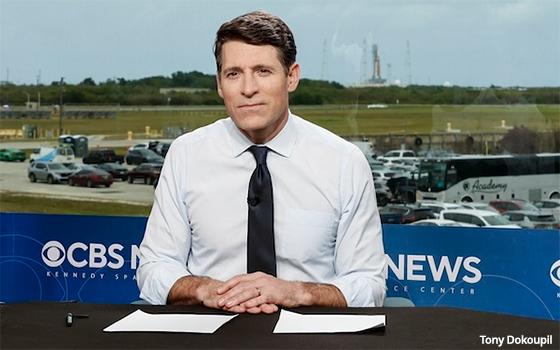
Anchorman Tony Dokoupil this week flew to the defense of
the new leadership regime at CBS News led by internet firebrand Bari Weiss.
“It’s not the experience I’ve had,” Dokoupil said in an
interview with The Wall Street Journal -- referring to the allegations of editorial interference that have led to high-profile rebellions and firings under the reign of Weiss.
Dokoupil portrayed Weiss’s input into each day’s story list for “CBS Evening News” as a professional, genial give-and-take between a
newscast’s editorial staff and their editor-overseer.
“When it comes to Bari Weiss, she’s the editor-in-chief, she runs a 9 a.m. meeting
and has lots of ideas,” he said. “When we like the idea, we use it. If we don’t, and if it doesn’t work for our show, we don’t.”
advertisement
advertisement
Dokoupil also said he has never heard a comment on the direction or editorial choices of “CBS Evening News” from Paramount CEO David Ellison, who hired Weiss with a mandate to
shake up the news division.
“He’s never had a comment about my show,” said Dokoupil, who has worked at CBS News since 2016.
“He’s never called me to complain about coverage. If he tried to, it wouldn’t have an impact.”
Based on all of the stories of tumult
that have come out of CBS News for more than a year -- some of it predating the arrival of Weiss last October -- it is possible to react to Dokoupil’s assurances of relative peace with
skepticism.
For one thing, Dokoupil was elevated from the CBS morning show to anchor of “CBS Evening News” last January in one of Weiss’s
first moves as editor-in-chief.
Since he has her to thank for this prestigious job, it seems natural that he
would do an interview in support of her.
But my own interpretation is that there is also a ring of truth, at least in part, to what he was trying to
say.
“She’s the editor-in-chief,” Dokoupil said of Weiss, which is an acknowledgement that as the boss of all things editorial, she has the
right to have the last word in editorial decisions.
Rebellion is -- or used to be -- interpreted as insubordination, traditionally a fireable
offense.
That was what happened to CBS News veteran Scott Pelley when he laced into the newly appointed executive producer of “60 Minutes,” Nick
Bilton, at the new boss’s first meeting with the show’s staff earlier this month. Pelley was fired the next day.
At the time, Dokoupil paid
tribute to Pelley on “CBS Evening News.”
"When I started at CBS, Scott Pelley was in this very
chair, and still doing a dozen stories a year for ’60 Minutes'," Dokoupil said.
“And amid all of
that, still meeting every new correspondent to share his view of the mission here,” he said. “He believed freedom of the press, to quote [James] Madison, was ‘the right that
guaranteed all the others’.”
“And the stakes are always that high in that, if you’d made it to CBS News, you were among the best in
the world. He worked every single day to live up to that standard,” Dokoupil said of Pelley.
But there has been one overriding narrative theme in
virtually all of the coverage of CBS News ever since Ellison’s Skydance was in the process of taking over Paramount last year.
And that is the
perception that pressure from upper management has been brought to bear on CBS News in order to win President Trump’s approval of last year’s deal and now, the pending merger of Paramount
and Warner Bros. Discovery.