B2B marketers are doing well for
the most part. But they are getting in their own way when it comes to data, judging by a study from Anteriad, conducted by Ascend2.
The group identified as
Data Heroes is a bit smaller in this year’s study: It now stands at 40%. And, overall, only 28% said they saw significant revenue increases during the prior year, down from 36% last year. Half
reported moderate hikes.
What’s causing this downturn? For one thing, brands are having problems managing and maintaining marketing data:
- Lack of high-quality or reliable data sources—48%
- Meeting data privacy and compliance requirements (e.g., GDPR, CCPA,
HIPAA)—44%
- Lack of alignment across teams on data definitions and standards—41%
- Inadequate data
infrastructure or workflows—32%
- Current technology can’t keep up with data management needs—29%
advertisement
advertisement
Similarly,
marketers face these issues in trying to use analytics to inform marketing decisions:
- Difficulty measuring performance across channels in one
place—35%
- Connecting marketing activity to specific buyers or buying groups—35%
- Identifying which marketing activities
drive pipeline creation—33%
- Connecting marketing activity to closed revenue—33%
- Limited visibility into audience behavior
and engagement—33%
- Lack of confidence in the accuracy or completeness of data—28%
- Difficulty defining or refining ideal
customer profile (ICP)—27%
- Insufficient internal resources to act on insights—25%
Despite
these problems, 31% of the respondents say their revenue increased significantly in the last year, and 45% that it rose moderately. Moreover, 31% report they greatly exceeded their goals, while 52%
met or slightly exceeded them.
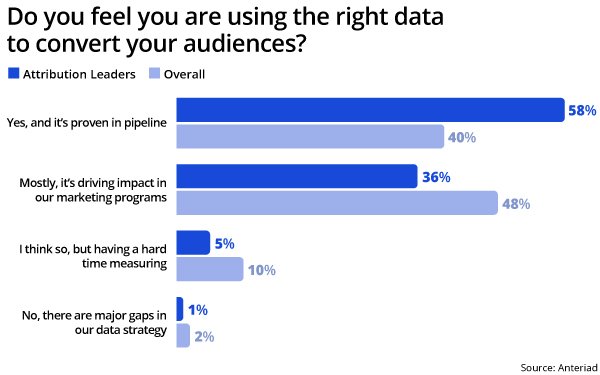
Of course, the real stars in this business are Attribution Leaders, who make up only 18% of the total. Of those polled, 58%
claim they are using the right data to convert buyers, compared with 40% of everyone else.
Attribution Leaders are planning to invest in the following channels over the next
12 months:
- Paid search—53%
- Paid social—47%
- Programmatic
display—40%
- Content syndication—40%
- Connected TV (CTV)—38%
- Digital audio
(podcasts, streaming radio)—36%
- Direct publisher/media buys—35%
- Reddit—35%
Overall,
these numbers far outpace those of marketers in general.
Where does email fit into the mix?
“Email is no longer just a distribution
channel; it has become the orchestration layer for modern B2B marketing, helping brands engage multiple stakeholders, personalize experiences, and move prospects through increasingly complex buying
journeys,” says Ascend2 CEO Todd Lebo. “Even as marketers invest in newer channels, our research found that 63% received larger marketing budgets in 2026, reinforcing that organizations
continue to prioritize channels.”
Finally, success also depends on the internal reporting structure. Asking the question for the first time, Ascend2 found that 36% report to
the CEO and 33% to a sales leader like the CRO, president or chief sales officer.
But get this: “No matter the reporting structure, alignment with finance matters as
much as alignment with sales,” the study reports. “When marketing and the CFO are not on the same page, the consequences are concrete: 39% of marketers face
increased scrutiny on spend, 36% see their budget reduced, and 35% experience delays in launching strategic initiatives."
The study methodology was
described as follows: “Anteriad partnered with Ascend2 to survey 631 marketing decision-makers across all levels of marketing leadership, located across the United States, United Kingdom, and
APAC. These marketers represent B2B and B2B/B2C organizations with 250 or more employees. The survey was fielded in March 2026."
The full report can be accessed here.