Sales and marketing professionals are
bogged down by tasks that keep them away from selling, judging by Pipedrive’s CRM Trends Report 2026.
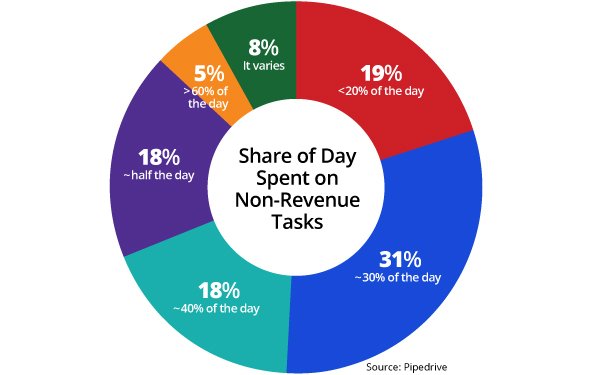
Of those polled, 42% say non-revenue-generating tasks take up at least
40% of their workday. Breaking it down, 30% spend 31% of their time on these chores, 18% waste 50% of their time, and another 18% waste 40%.
Only 11% cite prospect conversations and closing
deals as some of their most frequent weekly activities. For 38% it is logging emails, calls or meetings.
“The world’s most expensive data-entry clerks are salespeople,”
said Joe Futty, chief product and technology officer at Pipedrive. “We hired them to build relationships and close deals, yet too many spend more time feeding software than speaking with
customers. That’s not a people problem, it’s a software problem.”
advertisement
advertisement
A related problem is system fragmentation. A staggering 62% of the respondents say
disconnected tools cause their teams to miss important sales opportunities. But it depends on company size: Of those affected by this problem, 62% work at firms with fewer than 500 employees, while
only 11% are employed by enterprises with 5,000 workers.
All this is having a severe impact on the quality of life: 85% of professionals work outside standard hours at least one day a
week. But the heaviest toll is on Gen Z employees: 34% work three to four days a week beyond regular hours, compared with 24% of millennials and 24% of Gen X and 2% of the boomers still
working.
Don’t expect AI to take up the slack just yet. The most common uses of AI are “meeting, scheduling, task or reminder generation,” the study says. “Data
entry (26%) and prospect research (26%) see meaningful use too, but professionals aren’t satisfied: asked what they most want automated next, data entry jumps to the top of the list
(15%).”
It concludes, “The tools exist, but they’re not yet delivering on the work that matters most.”
Meanwhile, email continues to dominate in lead
generation. The study shows that leads come from:
- Email marketing—22%
- Organic social—15%
- References & word of
mouth—13%
- Paid advertising—13%
- Events/conferences—9%
- Partner/affiliate channels—7%
- SEO./inbound content—6%
- Cold calling—5%
- Other—9%
What works in email? Personalization, the top subject
line approaches being:
- Personalized (name/company)—25%
- Direct/transactional)—16%
- Value forward—13%
Pipedrive surveyed 1,000 professionals in June 2026.