The Supreme Court Monday rejected
former Federal Trade Commissioner Rebecca Kelly Slaughter's bid for reinstatement, ruling 6-3 that the president can fire members of the commission at will.
"Subordinates who exercise the
President's power are subject to removal by him," Chief Justice John Roberts wrote for the majority.
He added that a
provision in the FTC Act explicitly stating that commissioners serve for seven years, but could be removed for "inefficiency, neglect of duty, or malfeasance in office," is unconstitutional.
"We hold that such protection from removal is contrary to the separation of powers enshrined in the Constitution," Roberts wrote.
"In its present form, the FTC enforces and administers some
80 statutes, which cover almost every facet of our Nation’s economy," he added. "The tasks it undertakes are 'the very essence of "execution" of the law' -- precisely the President’s
constitutional role."
advertisement
advertisement
The decision explicitly overrules the 1935 case called Humphrey's Executor, in which the Supreme Court held that former President Franklin D. Roosevelt could only expel
an FTC commissioner for cause.
While the ruling only explicitly deals with the FTC, Roberts' reasoning would empower a president to oust members of other agencies including the Federal
Communications Commission.
President Donald Trump praised the decision, writing on Truth Social: "To show the
importance of the Slaughter Case, 90 years of precedent has been COMPLETELY AND UNEQUIVOCALLY OVERRULED, greatly increasing Presidential Power at a time when it is most needed!"
The ruling
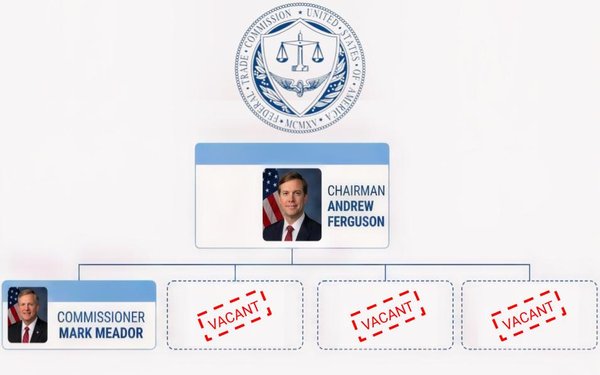
came in a battle dating to March 2025, when Trump ousted Slaughter and Commissioner Alvaro Bedoya, both Democrats, leaving the agency with only Republicans.
Slaughter and
Bedoya sued for reinstatement, arguing that Congress established the FTC as a five-member agency, and provided that members could only be removed for cause. (Bedoya resigned from the FTC while the
case was pending and dropped his bid for reinstatement.)
The advocacy group Public Knowledge, which sided with Slaughter in a friend-of-the-court brief, called Monday's decision "dangerous for
democracy."
“People depend on the FTC to police mergers, stop deceptive practices, and protect privacy," Public Knowledge legal director John Bergmayer stated. "A commissioner who serves
at the president's pleasure will think twice before voting to investigate a politically connected company. Policies may undergo much more rapid shifts from one administration to the next, and an
agency once seen as an impartial check on corporate power will be seen as just another political actor."
Despite the broad language in the opinion upholding Slaughter's ouster, the Supreme
Court Monday appeared to suggest there are limits to a president's power to fire Federal Reserve Board governors.
In that matter, the court in a 5-4 ruling preserved an injunction barring Trump from immediately firing Governor Lisa Cook.
That decision was also authored
by Roberts.
Justices Sonia Sotomayor, Elena Kagan and Ketanji Brown Jackson dissented from the ruling that allowed Trump to fire Slaughter, while Justices Clarence Thomas,
Samuel Alito, Neal Gorsuch and Amy Coney Barrett dissented from the ruling that enabled Cook to at least temporarily remain on the Federal Reserve Board.