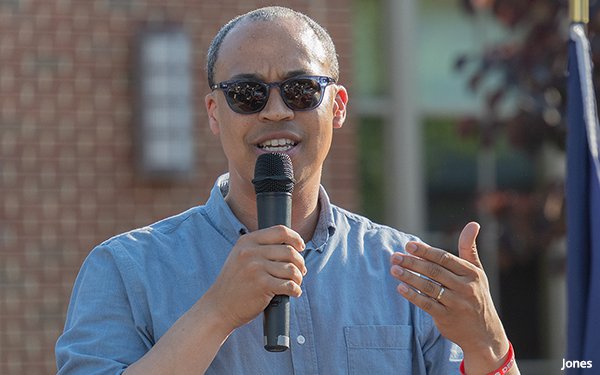
Virginia Attorney General Jay Jones is pressing a
federal appellate court to immediately allow enforcement of a state law imposing time limits on minors' use of social platforms.
"Social media is addictive and harmful to
children,” Jones argues in a renewed motion to lift a block on SB 854.
That law, passed last year, requires social
platforms to verify users' ages, and prohibit minors under 16 from accessing social media for more than one hour a day without parental consent.
"The statute strikes a careful
balance between social media access and overuse," Jones argues in the motion, filed last week with the 4th Circuit Court of Appeals.
The measure had been slated to take effect
in January, but was blocked on First Amendment grounds by U.S. District
Court Judge Patricia Tolliver Giles in Alexandria.
advertisement
advertisement
She said in a written ruling that Virginia "does not have the legal authority to block minors’ access to
constitutionally protected speech until their parents give their consent by overriding a government-imposed default limit," and prohibited officials from attempting to enforce the statute against any
NetChoice members.
NetChoice, which sued over the law,
counts big tech companies including Meta Platforms, YouTube, Reddit, and Dreamwidth as members.
Giles also said in the ruling that the law's age-verification requirements would
impede adults' ability to access lawful speech.
Jones previously asked the 4th Circuit to lift the block, but the court rejected that request because Jones had not first asked
Giles to stay the injunction.
Jones subsequently petitioned Giles for a stay. As of July 7, she has not ruled on that request.
Jones argues in the new motion that law
"targets social media addiction and imposes only incidental hurdles to accessing social media."
He also contends that NetChoice failed to prove "that any child will be
prevented from accessing desired content or that any platform will be unable to convey their own expression in that time."
Jones also argues that the age-verification
requirements don't "meaningfully impair adults' access to social media," writing that the requirement is comparable to laws mandating that people provide proof of their ages before purchasing
alcohol.
Virginia is just one of numerous states to pass laws that attempt to regulate social-media use by minors.
Other states with comparable statutes
include Arkansas, Florida, Georgia, Louisiana, Nebraska, Mississippi, Ohio, South Carolina, Utah, Texas and Tennessee.
Most district court judges have blocked all or part of
those measures, but state attorneys general have appealed and three appellate courts have sided with state officials and allowed enforcement of laws in Mississippi, Florida and Ohio.