Email teams can empathize with their
colleagues on the paid media side in at least one respect: post-click activities are critical for both, but they are often the first thing to be cut when brands are trimming their costs, judging by a
new study from Unbounce, conducted by Ascend2: “The state of paid media ROI.”
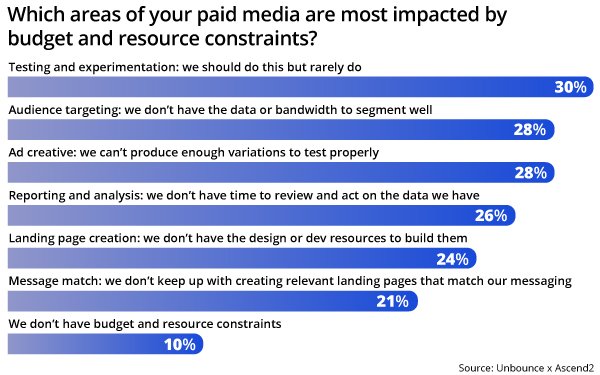
Of the marketers polled, 90% are facing paid media budget and resource constraints. These
include:
- Testing and experimentation: We should do this but rarely do—30%
- Audience targeting: We don’t have the data or
bandwidth to segment well—28%
- Ad creative: We can’t produce enough variations of test properly—28%
- Reporting and analysis: We
don’t have time to review and act on the data we have—26%
- Landing page creation: We don’t have the design or dev resources to build
them—26%
- Message match: We can’t keep up with creating relevant landing pages that match our messaging for every campaign—21%
- We don’t have budget and resource constraints—10%
advertisement
advertisement
How many of these issues have you experienced, emailers?
“Email marketers should see these research findings as validation that the click isn't the goal; it's the starting point," says Todd Lebo, CEO of Ascend2. "Whether someone arrives from an
email or a paid ad, the experience that follows determines whether interest turns into action, making optimized landing pages and thoughtful and strategic follow-up just as important as getting the
click in the first place.”
And where is the budget money going? Brands have invested in these areas over the past six months to improve campaign
performance:
- Audience research and segmentation—40%
- AI tools for paid media—39%
- Ad creative or copy production—38%
- Landing pages—31%
- Ad platform tools—30%
- Attribution and
tracking—28%
- A/B testing or experimentation—26%
- Ad platform automation—24%
- None of these—7%
As you can see, pre-click is getting more resources than all-important post-click.
Speaking
of which, here is where marketers are sending their paid traffic:
- Existing pages on our website (product, service, or category
pages)—28%
- Our homepage—25%
- Dedicated landing pages built for specific campaigns—24%
- General/reusable landing pages that work across multiple campaigns—21%
- Other—1%
"Keep in mind that 40% of marketers who
say that ‘direct sales’ is their number one goal are sending paid traffic to existing website pages,” the study states. “But product and category pages are built for general
audiences, not converting.”
Indeed, “marketers are spending their budgets narrowing their audience by industry, company size, pain point, funnel stage, job
title, intent, interest, and retargeting behavior,” the study notes. "However, more than half of marketers (53%) send that carefully crafted audience to generic webpages."
Sound familiar, anyone?
Let’s end on a positive note. Here are the practices that marketers see as the best ways to optimize paid traffic
spend:
- Tighten audience targeting—49%
- Optimize the destination pages—40%
- Cut underperforming channels
or campaigns—38%
- Shift spend toward higher-intent platforms or keywords—35%
- Set target caps for spend—34%
- Reduce
creative variants—24%
- Pause testing and experimentation—19%
- Other—1%
Unbounce and Ascend2
surveyed 304 paid media professionals in both leadership and non-leadership roles in May. The respondents work for agencies and brands in the United States with up to 1,000 employees.
The full study can be accessed here.