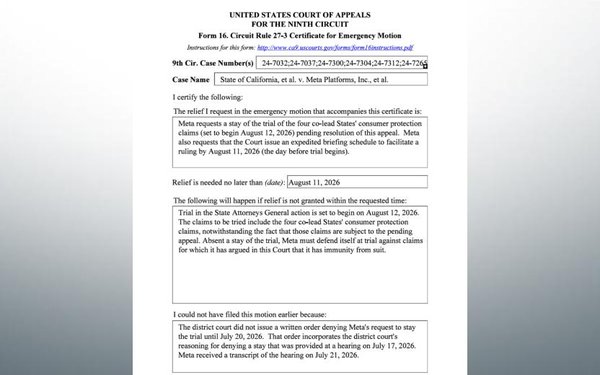
Meta Platforms is asking a federal appeals court to issue an
emergency order blocking states from proceeding to trial next month over claims that the company harmed teens.
Absent intervention by the 9th Circuit Court of Appeals, attorneys general from
four states -- California, Connecticut, Kentucky and New Jersey -- will face off against Meta on August 12 in front of U.S. District Court Judge Yvonne Gonzalez Rogers in the Northern District of
California.
The states' complaint includes claims that Meta violated consumer protection laws by misrepresenting that its platforms are not designed to be addictive, and by harming young
users. Among other allegations, the attorneys general contend that design features such as algorithmic recommendations and videos that play automatically are addictive.
Meta previously urged
Rogers to dismiss those claims for numerous reasons, including that it is protected from liability by Section 230 of the Communications Decency Act. Section 230 broadly immunizes web companies from
lawsuits over content posted by users, including potentially harmful content.
advertisement
advertisement
Rogers partially rejected that argument, ruling earlier in the proceedings that some addiction-related claims were
precluded by Section 230, but that others could move forward.
Meta appealed that ruling to the 9th Circuit, which heard oral arguments in January but has not yet issued a decision.
The
company now contends that any trial should be delayed until after the 9th Circuit rules on Section 230's applicability to the claims.
"This court should stay trial on the consumer protection
claims until it resolves the pending appeal," Meta's attorneys write in their emergency request, filed late Wednesday with the appellate court.
A total of 29 state attorneys general are suing
Meta in federal court, and numerous others sued the company in state courts.
The platform also faces addiction-related lawsuits by local school districts, cities, teens and their families.
Other defendants in many of those suits include Google, TikTok and Snap.
So far, two of those cases have resulted in jury verdicts against Meta. In March, a jury in New Mexico found Meta liable for violating that state's consumer-protection law and
ordered it to pay $375 million.
Also in March, a state-court jury in Los Angeles found Meta and Google's YouTube liable for harming a young woman's mental health by designing their services to
be addictive. The jury assessed damages at $6 million, and said Meta should pay 70% of that figure and Google should pay 30%.
A second trial that would have pitted a teen against Meta had been
scheduled to commence in state court in Los Angeles next week, but the teen abruptly withdrew his claims on Tuesday.
That teen, identified only by the initials R.K.C., recently settled a
similar matter against three other platforms -- TikTok, Snapchat, and YouTube.
Meta spokesperson Andy Stone said Tuesday in a post
on X that R.K.C.'s claims "never held up."