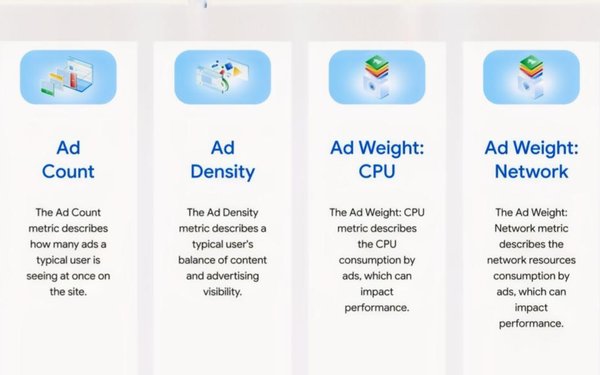
Google has introduced four new
experimental ad-detection tools with the goal of providing additional metrics for paid media teams that buy and sell advertising, as identifying the value of website visits have become more
challenging for advertisers since the introduction of artificial intelligence (AI).
The tools, announced Tuesday, are built into the existing Chrome User Experience Report framework (CrUX)), and are designed to help these teams better
assess audience advertising experiences, Alex Cone, group product manager at Google Chrome, wrote in a blog post.
advertisement
advertisement
He
listed the new ad metrics as "Ad Count," which averages the number of ads in view; "Ad Density," the average fraction of the viewport area occupied by ads; "Ad Weight," which refers to network
use -- the resources consumed by ads measured in bytes -- and "Ad Weight," which refers to CPU use, the resources consumed by ads measured in milliseconds."
"These new CrUX ad metrics provide
a more complete picture of a user's experience on the web," Cone wrote. "They expand the aggregate data already publicly available in CrUX by reporting on four dimensions of a site's ad
experience."
The new CrUX ad metrics are reported on the same dimensions and follow the same eligibility criteria as Google's existing Web measurements.
This means advertisers will see
these metrics broken down by elements like device type mobile vs. desktop, and connection speed such as 4G, 5G, and Wi-Fi.
Notably, Cone wrote
that CrUX ad metrics are not part of Core Web Vitals and do not have suggested targets or thresholds.
Kevin K. Lee, senior developer relations engineer at Google Chrome, in a
separate blog post noted CrUX ad metrics measure the values in a 28-day rolling window to capture how real users experience the site across different devices and network conditions.
"The
metrics measured from real users are called field data," he wrote. "We also provide tooling to measure these on the developer's local
device (lab data) to provide immediate feedback for local development and debugging."
The data collected from Chrome users who opted in to having browsing experience measured anonymously. The
data comes from Chrome users on Android, ChromeOS, Linux, MacOS, and Windows. Chrome on iOS are excluded.