That's what I'm asking this morning after
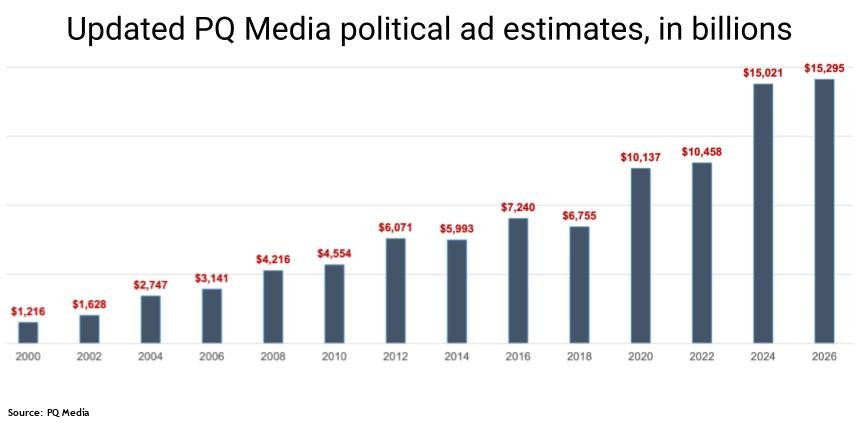
receiving PQ Media's just-published U.S. political ad spending update. The update, first reported by the Radio Advertising Bureau (RAB), projects this
year's midterm election spending will reach $15.3 billion, an increase over 2024's presidential election year spending of $15.0 billion, according to PQ's tabulations. That would make this year the
second midterm after 2022's to surpass the preceding presidential year ad spending.
In other words, is it time to think less quadrennial and more biennial?
Mid-term growth over a
presidential election cycle "was not the norm during the 2010s (2014 and 2018 elections)," PQ Executive Vice President-Research Leo Kivijarv writes in a post on the RAB blog, noting, "Instead,
this year’s election mirrors the 2022 election, when there was positive growth as well."
advertisement
advertisement
He goes on to add a caveat, calling the 2022 mid-term spending surge to "an anomaly attributed to
the impact of the pandemic, in which political parties were forced to cut spending during the 2020 election on certain media," creating a lower baseline for 2022.
He also implies a 2026 anomaly,
attributing this cycle's growth to "the growing divide between and within the two parties, as elections are getting increasingly contentious each election cycle, per analysis by the Wesleyan
University Media Project."
But back to my question: Is that an anomaly or a a new normal? Does anyone else see elections growing less contentious in future election cycles?
By the
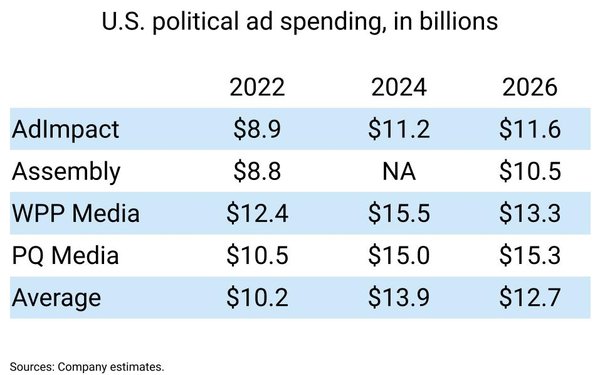
way, PQ is not alone in handicapping this mid-term election's growth over the 2024 presidential election. AdImpact's most recent forecast also projects 2026 increasing over 2024 (see table
below).
And following the Supreme Court's ruling lifting limits on how much
dark money can fund political party ad spending, I don't see this trend reversing anytime soon.