In a 6-to-3 decision, the Supreme Court of the United States lifted
the limits political parties -- and the entities that fund them -- can spend on coordinated ad spending with candidates.
The ruling on the campaign finance case "National Republican Senatorial
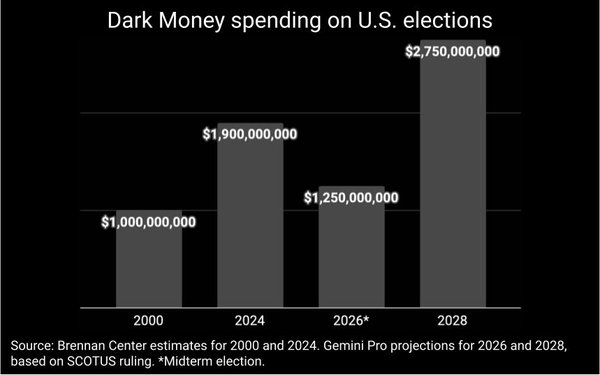
Committee v. Federal Election Commission" follows the Roberts Court's 2010 "Citizen United v. Federal Election Commission" ruling, which already accelerated the amount of so-called "dark money"
funding U.S. election campaign advertising.
The new ruling is expected to pour even more money from wealthy donors and special-interest groups into the political media-buying marketplace.
“The U.S. Supreme Court has opened a new avenue for wealthy donors and special interests to buy favor with political candidates,” democracy advocacy group Issue One Director of
Money in Politics Reform Michael Beckel said in a statement reacting to the decision. "By eliminating the limits that have long governed how much money parties can spend in coordination with
candidates, the Supreme Court has further empowered wealthy donors and special interests with outsized influence in elections."
advertisement
advertisement
The ruling also is expected to fuel the amount of money going
into so-called "hybrid" political advertising buys, funded by parties and issues groups, but coordinated with candidates qualifying for lowest unit rate ad prices from linear broadcast stations and
networks.
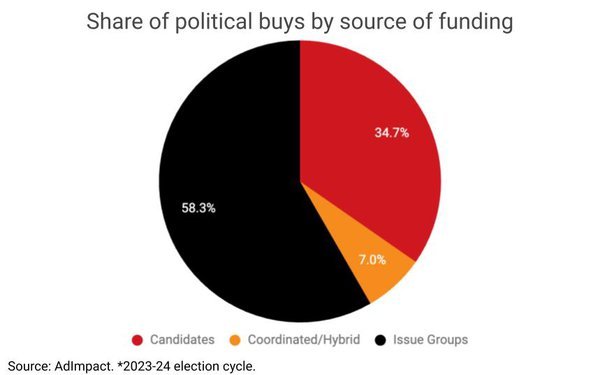
The hybrid ads have already been accelerating -- representing 7% of total political ad buys during the 2023-24 cycle -- and are expected to grow even more this cycle, especially
after the SCOTUS ruling.
"I think there’s a few immediate effects of this ruling for the 2026 cycle, but the real impact will be in the 2028 cycle," says Tyler Goldberg, director of
political strategy as Stagwell's Assembly Global unit.
"TV stations will theoretically be seeing less money, because more linear advertising will qualify for the lowest unit rate."
That said, Goldberg predicts that increased demand from coordinated advertising will actually drive lowest unit-rate costs in competitive markets, becasue more well-financed coordinated buys will
qualify for them.
Federal laws requiring stations to sell advertising for the lowest unit rate does not currently apply to digital media, including CTV ad platforms, but Goldberg predicts that
may be the next shoe to drop, as digital media currently represents more than three-quarters of the total advertising marketplace.
"The main effect initially will be on linear advertising," he
notes.