Well, not completely. At least not yet. But given the rate
of progression its just a matter of time before most of what we experience -- at least in the digital world -- is synthesized by machines.
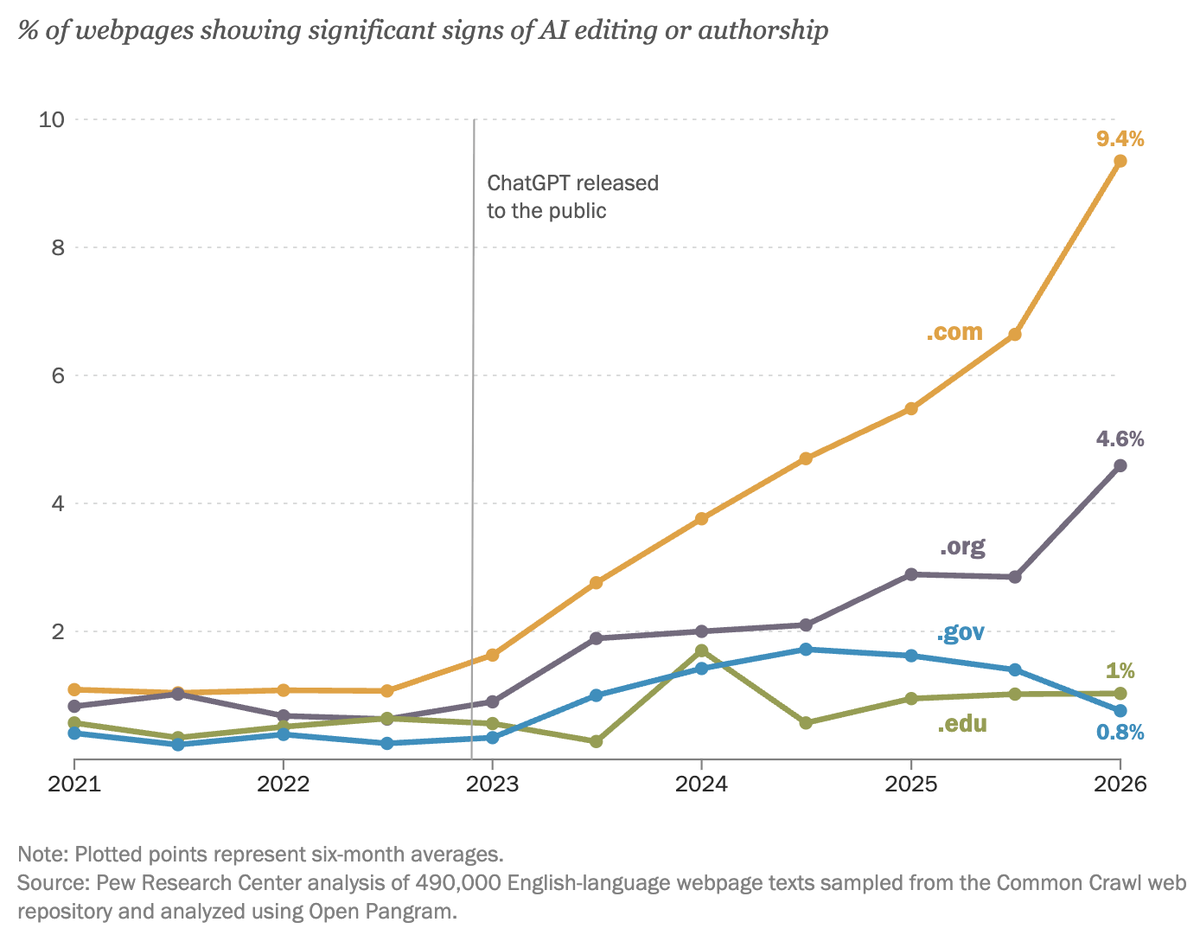
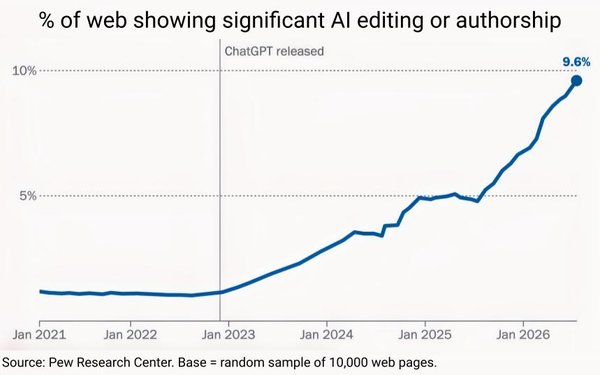
Right now, it's nearly 10%, according to new research released today by the Pew Research Center, which has been tracking the percentage of web
pages significantly edited or written by AI.
In the four years since OpenAI made ChatGPT available to the general public, the synthetic share of Web content has risen tenfold -- from about 1%
to 9.6%.
advertisement
advertisement
Given that rate of progression, I asked ChatGPT how long it would take before the majority of the web is synthetic. Assuming the same compound rate of annual growth, we would reach
that tipping point by mid-2029.
"Obviously, that curve can't continue indefinitely," ChatGPT added, noting that "adoption curves normally slow as they mature. A logistic/S-curve model would
therefore probably put the crossover later than 2029 but much earlier than 2044."
Personally, I'm not so sure, because while adoption rates of AI may eventually flatten, not use cases --
especially content generation -- will continue to accelerate among people (or their agents) utilizing AI to make things, especially content.
I think a better analogy than simple tech adoption
rates would be social media usage.
While the growth of the major social-media platforms has flattened, the amount of content published by users/creators/influencers, etc. -- including many
virtual ones -- continues to explode, thanks in part to access to AI content-generation tools.
The point of this column is not about if and when the synthetic tipping point will come, it's
about what the meaning of that is or will be. And if you ask me, the answer is, well, meaning. Or more to the point, meaningfulness.
As the amount of synthetic content and/or experiences
proliferates, what we need is the means and mechanisms to determine what and how much of it is actually meaningful.
And by that, I don't just mean slop. I also mean AI's propensity to distort
what is meaningful -- whether by explicit hallucination, extrapolations of misinformation, willful applications of disinformation, or perhaps most importantly, the biases inherent in the sources that
AI uses to output meaning.
Currently, those sources are mostly digitally accessible ones, so right there AI has a pronounced bias against information in the real world that is not digitally
accessible.
I'm not even going to throw out a rough guess of what that is, but I'm going to say it is the vast majority of actual information -- although for practical purposes in contemporary
society, if information isn't digitally accessible, it doesn't matter to many people, unless they are scientists.
And within digitally accessible information, there are also significant AI
biases because much of the most influential information is behind walls they cannot access, unless they are enterprise AI accessing proprietary data or have licensed access to it.
I'll let you
estimate what you think the shares of those forms of information are, but my main point is one of the oldest ones in the information age: garbage in, garbage out.
I've been thinking about the
acceleration of synthetic information for some time, and I don't think all of it is necessarily bad. In fact, I think smart people using AI, or smart AI understanding what's actually relevant to
people, can do something better than people or AI could do on their own.
I'm still thinking about how that would work, but in the meantime I think we need a tool to help us understand what
parts of the growing morass of synthetic content actually is meaningful.
My initial thought was that it should be like some research Havas developed years ago to determine which brands were
most meaningful in a world full of rapidly expanding brand choices.
Havas has been conducting its "Meaningful Brands" research since 2009 and once
of the best parts of it is a question they ask consumers worldwide: "If this brand disappeared tomorrow, would you care?"
The percentages have changed year-to-year, but based on its must
recent research, 78% of brands could disappear tomorrow, meaning only 22% of brands are actually meaningful.
There is more nuance than that in the research, but you get the drift.
I
think someone should come up with a similar way to measure the amount of information -- synthetic, manual, hybrid, concocted or whatever -- that is actually meaningful to society. And I'm guessing at
least 78% of it could disappear tomorrow and most of us would not care.
Disclaimer: This column was written entirely by a human with zero AI editing or authorship involved.