Can AI-created ads outperform human-made ads and improve business
outcomes? The good news – at least for those of us on Team Human – is no, according to a novel study from Ipsos and a team of researchers at Syracuse University’s S.I. Newhouse
School of Public Communications. The not-so-good news? There wasn’t that much of a difference.
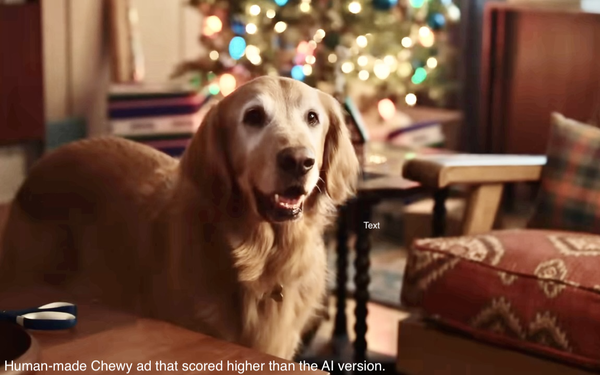
In the study, called “AI Ads Are Good Enough – And That’s The Problem”, researchers took 10 real 30-second ads from brands
like Cheerios, Febreze and Chewy. Using AI, they worked backward to write the creative brief behind each one. Then they used AI to turn that same brief into a new ad, with no human editing. Each pair
of ads shared the same strategy, and only the maker was different. Ipsos then tested all 20 ads on 3,000 U.S. consumers, and measured effectiveness based on sales-validated metrics, predicting
real-world business outcomes. Short-term, human ads did about 14% better. Long term, that advantage rose to 17%. But certain AI-generated ads did beat human ones.
advertisement
advertisement
Adam Peruta,
associate professor at Syracuse University and co-author, explains that while AI ads are quite credible, that’s not the same as compelling.
This interview has been edited for length
and clarity.
Marketing Daily: What is the most important take-away for CMOs and marketers?
Adam Peruta: These 10 ads spanned various categories, and the AI ads
were not seen as effective as the human-made ones. But that was overall. AI ads did better for ads that were more functional, describing product benefits. For example, the AI ads for Febreze and
Herbal Essences outperformed human-made ads. These are very formulaic ads, and that approach has been used since the beginning of advertising. AI is really good at that. But when the creative brief
asks for something deeper, whether it's to focus on a human truth or use humor, AI came up short.
Marketing Daily: Another finding -- and I know it wasn’t the point of your
research -- was that consumers by and large couldn’t tell if an ad was AI- or human-made. Indulge me here, because I write and read about AI in advertising all day long, and I’m deeply
embarrassed that I fail almost every “Real or AI?” quiz. Am I normal, or an AI dunce?
Peruta: I teach at Syracuse University, considered to be the best comms and media
school in the country. We have smart students, and they are digital natives. They’re supposed to be good at this. It comes down to a coin flip, and I think I’m only slightly better than
50/50. In this research, when consumers saw the ads in a distracting environment, it was likely worse.
Marketing Daily: Do you think consumers care?
Peruta: No. Part of
this research involved telling people, “The ad you just saw was AI. Does it change how you feel about the brand, or your trust in the brand?” And 54% said no, which blew me away,
especially given the backlash against the Coca-Cola holiday ad last year. It’s confusing: consumers will tell you one thing about their feelings toward AI, but the numbers tell a different
story.
Marketing Daily: CMOs tell us they are often fending off CFOs, who want to know why marketers can’t use AI more to spend less.
Peruta: I would say that we
have to test to make sure that our human judgment of the ads delivers on brand strategy. And we need to make sure that we have strong creative briefs grounded in the research insights, cultural
interpretation and emotional connection.

Marketing Daily: If I’m playing the CFO in that conversation, though, I’d push back and say, “Hey, look at Cheerios. The AI-produced ad scored a 155 in creative
effect, while the human ad -- the ones actually created by General Mills -- only got a 148."
Peruta: That’s a difference of only seven points. And I want to point out that Ipsos
developed a numerical range of acceptable scores, and all 20 of these ads -- human- and AI-made -- fell within it. So the story isn’t “Oh my God, AI really bombed.” The only brand it
scored really poorly on was Fiat. For Cheerios, my hypothesis is that Cheerios had a very strong brief, very clear, backed by research. That means AI had more context to work with, and so it could
make a better ad.
Marketing Daily: This idea that the AI ads are all in the realm of acceptable is tricky. Aren’t marketers always supposed to demand excellence: “'Good
enough’ is not an option!” But they are also managing resources, and sometimes have to say, “Sorry, Shakespeare, lower the bar -- we are only authorized X hours and your time is
up.”
Peruta: That’s an important takeaway: What is the low-hanging fruit? Where can we use AI to work faster, to speed things up, to save money? Do we even need an agency
anymore? Can we do this in-house? If you are testing AI in your creative and the ads are testing well, then I would certainly lean into it. But realize that it is also possible that short-term time
and money savings may look good now, but can come back to bite you in the long run.