Waymo continues to lead the way in robotaxis, with more than
10 million rides and a 93% satisfaction rating from riders, according to the company, a subsidiary of Alphabet, Google's parent company.
I was in Austin, Texas recently and hoped to
go for a ride in that newly added city. But the company has partnered with Uber there, so there's no way to choose a Waymo on the rideshare app. The company has the same arrangement in Atlanta. It
will soon be expanding to a dozen more U.S. cities, including Denver and Detroit.
I have been able to take three rides total, two in Los Angeles
and one in San Francisco. The company is also operating in Phoenix,
including rides to and from the airport there.
advertisement
advertisement
I had a new experience during my second Waymo ride in Los Angeles recently. I was going to dinner with two colleagues, so I hopped in
the front seat to sit shotgun with the invisible driver while my friends, who had never been in a Waymo and were a tad anxious, sat in the back.
You can’t sit in the
driver seat — only the front passenger seat is available to any rider who is at least eight years old. If you sit in the front, you can interact with the in-car screen, but Waymo asks that you
don’t touch any other controls. I didn't touch anything -- but then again, I also don't touch controls in my friend's cars.
Being up front is definitely different from sitting
in the back. But I have yet to have an unpleasant or scary experience in these vehicles. I stand by my longtime observation that robots almost always drive better than humans.
For starters, they don’t go over the speed limit, and they don’t get impatient and take unnecessary risks. It’s as boring and emotionless a ride experience as you can get.
My friends said they felt safe during the short ride.
The Waymo Driver uses lidar, radar and cameras combined with software to perform the entire act of driving. The Waymo
Driver sees and understands the world through a number of sensors, including cameras outside the car, and artificial intelligence software — a process that the company calls “Sense, Solve,
Go.”
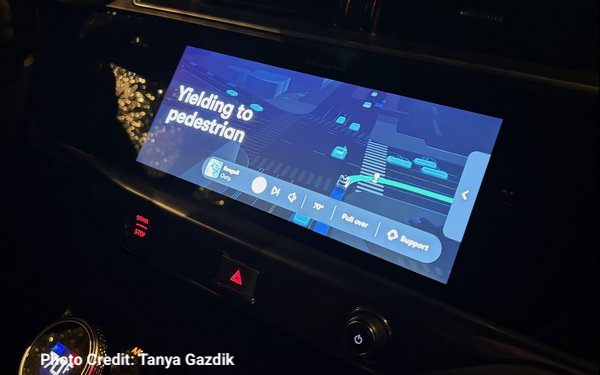
Indeed, the screen indicated when it “saw” and yielded to pedestrian, in case anyone in the car was wondering about the pause in driving (see photo
above).
The company recently announced it was expanding its range to include freeways, and I was hoping to take a ride that included some higher speeds. But when I tried to book a
car from downtown L.A. to Santa Monica, I saw that the route was going to be completely on surface streets, so I ended up booking with a faster non-Waymo rideshare instead.
Omega Law Group has been analyzing ride data of over 25.3million fully autonomous miles. and has found 88% fewer property-damage claims and 92% fewer bodily-injury
claims compared with traditional human-driven vehicles.
Those are safety statistics even skeptics can’t argue with.