It has been seven years since the editors of MediaPost awarded a media
"Disrupter of the Year," and the last time we bestowed it, it was awarded to Russia's Russia's Internet Research Agency for the ingenious way
it disrupted the 2016 U.S. presidential election via a mostly organic disinformation campaign utilizing social media.
We never repeated it as one of our official Agency of the Year categories
again, and close observers may have noticed that MediaPost has also culled our official categories down to just four this year.
advertisement
advertisement
But beginning with this "Red, White & Blog"
post, we will be publishing a series of unofficial "Editors Picks" for the agencies and agents we believe merit attention for their media industry efforts over the past year, including once again
naming a "Disrupter of the Year."
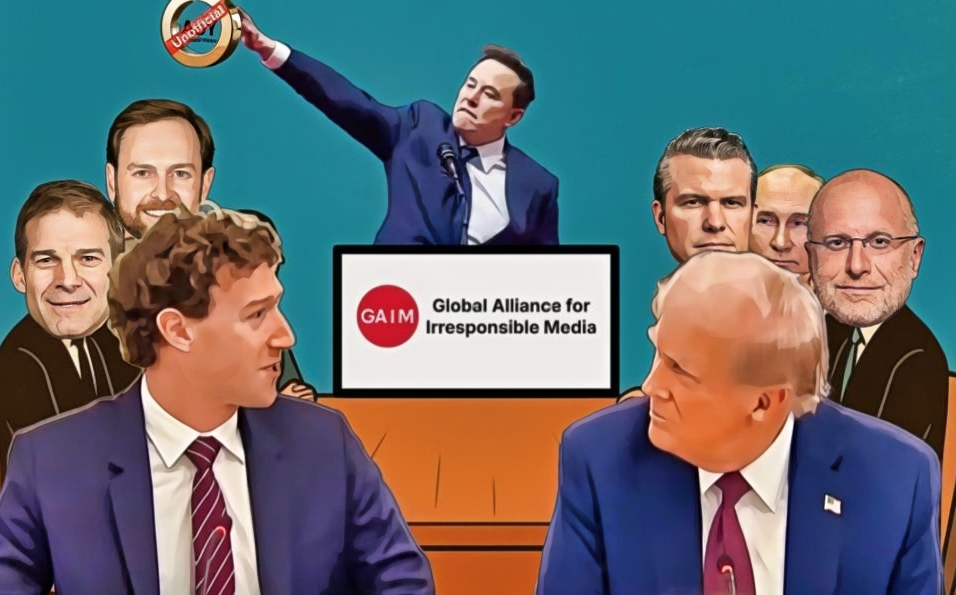
This time, we're awarding it to the Global Alliance for Irresponsible Media (GAIM) for unravelling public, private and regulatory efforts to create a more
responsible and fact-based media information marketplace.
As the collage above illustrates, GAIM is not a single entity, but an amalgamation of agents and agencies -- including many of
America's most powerful federal ones -- to eradicate, or at least hobble, long-established safeguards protecting society from the spread of disinformation and other forms of irresponsible
media.
We're not claiming that GAIM is an organized entity. In fact, it's a concept we're making up simply to organize a disparate group of actors who coincidentally, or not, have worked
toward the same end to promote disinformation, discord and a far less responsible media environment, especially for young people and other impressionable minds.
While much of those efforts
have manifested in the U.S. as part of the new administration's escalating attacks on responsible media, and increasing pressure on the less-than-responsible ones to become even more so, some of it
has been global in nature, starting with Elon Musk's lawsuits that led to the shutdown of the World Federation of Advertisers' Global Alliance for Responsible Media (GARM) and continued litigation
agains the WFA and some of its biggest members.
Musk's corresponding eradication of Twitter/X's content-moderation policies and organization, as well as Meta's decision to follow suit, also
are global in nature.
And while it's hard to see how Russia -- or other hostile foreign actors -- have been contributing to the undermining of a responsible, fact-based media marketplace,
there is anecdotal reporting from watchdog organizations like NewsGuard that continue shedding light on some of it.
Domestically, while some of the federal agencies' attacks on responsible
media appear politically motivated -- especially the Federal Communications Commission and the Federation Trade Commission -- much of it simply is targeting efforts to moderate disinformation.
Earlier this year, the FTC began probing London-based Global Disinformation Index, an independent, non-partisan organization shedding light on bad
disinformation actors worldwide, including AI- and human-generated ones.