Whether you lean right or left, everyone can probably agree that Oh-Oh-Oh-Ozempic is advertising too much. Our current Health and Human Services Secretary, Robert F. Kennedy Jr., has long
criticized the practice of allowing pharmaceutical companies to advertise directly to consumers, which is legal only in the United States and New Zealand.
Despite RFK Jr's public position,
imposing a total ban would face significant legal hurdles, including challenges related to corporate free speech. And there is a hefty lobby investment from the pharma industry.
According to
the website Open Secrets, $16+ million was spent by Pharmaceuticals/Health Products PACs to candidates in the year 2023-2024, of which $7.1+ million went to Democrats and $8.8+ million to
Republicans.
So any changes are likely to be complex and slow, if they happen at all, and we will have to continue to suffer from overkill in ad breaks for the foreseeable future.
How
much overkill, you ask? Here is a stat from eMarketer:
advertisement
advertisement
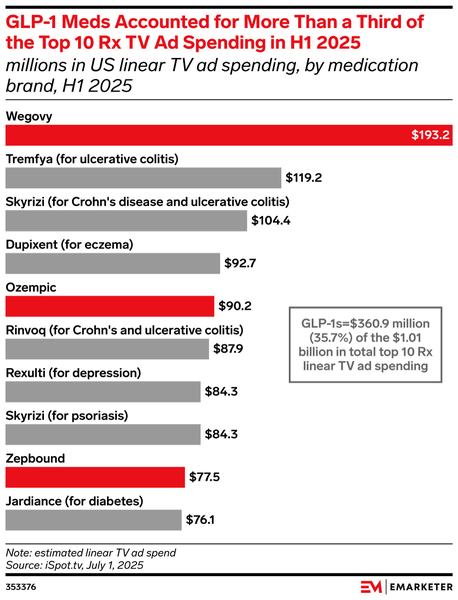
Approximately 1 million people in the United States have ulcerative colitis (UC), or around 1.0% of the population, though overall irritable bowel disease (IBD) estimates are higher, with some
sources placing the total number of adults living with IBD (including UC and Crohn's disease) as high as 3.1 million. That is still a very small percentage. Yet ad spend for medicines for this
category is ranked at number two, three and six on the above table.
In the U.S., around 31.6 million people (roughly 10% of the population) have some form of eczema. According to the National
Psoriasis Foundation, approximately 8 million people, or roughly 3% of the population in the United States, have psoriasis.
Critics of pharma advertising often state that pharma ads routinely
overemphasize benefits, only partially inform its audience, and create “pressure to prescribe” for doctors when there are cheaper, non-branded alternatives available. But given this is a
marketing and advertising platform, let’s look at it from that angle.
I am going out on a limb here to say that if you are targeting less than 10% of the U.S. population, you have no
reason to be spending money on broad-reaching media like network, cable or streaming TV. These are among the most expensive touchpoints you can buy as a marketer. Yes, it lends prestige and still
delivers probably the most powerful connection with consumers, but the amount of waste these brands are willing to absorb seems out of proportion. Especially when there are much more cost-efficient
alternatives available, even for video ads.
If conversion is your metric to apply, I am going to guess those numbers also look bad for TV/cable/streamer networks. But the most important metric
-- “sheer, unfiltered hatred for the overkill frequency of these ads and the seemingly unlimited funds to advertise” -- is perhaps the most important one. If I was in charge of one of
those brands, I would be a contrarian and schedule differently, both in choice of platform as well as frequency. But what do I know?
This post was previously published in an earlier edition
of Marketing Insider.