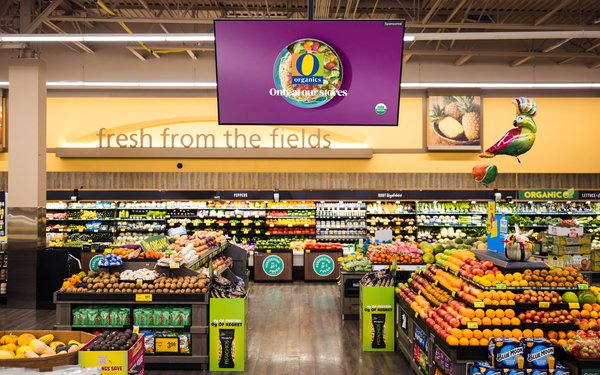
As CPG brands push deeper into in-store media,
one problem remains: proving the ads actually drive sales.
At CES this week, Albertsons Media Collective unveiled a new in-store incrementality measurement
solution designed to show what many CPG brands have wanted to believe but struggled to prove: that in-store screens can drive net-new sales, not just capture purchases that would have happened
anyway.
The offering uses a matched-market framework that compares test stores exposed to in-store media against a rigorously selected control group with no
media exposure, isolating advertising as the sole driver of lift. The supermarket giant says the methodology estimates the counterfactual — what would have happened without ads — and
delivers a statistically validated measure of true incremental impact at the store level.
advertisement
advertisement
“For too long, in-store media has been measured with tools
that confuse correlation for impact,” said Liz Roche, vice president of media and measurement at Albertsons Media Collective, in the release. “Our matched market incrementality approach
cuts through that noise.”
The launch builds on Albertsons’ in-store digital display network and targets a persistent industry challenge: physical
retail operates outside the signal-rich, identity-connected environment that makes digital media relatively easy to measure. Albertsons says its framework leverages nearly 60 variables for store-level
matching and works across both existing and new in-store screens, including deli and pharmacy placements.
In beta testing, Mondelez promoted Sargento Cheese
Bakes, integrating in-store digital screens with high-engagement onsite and offsite media in 116 Albertsons banner stores. Measured using Albertsons’ matched-market methodology, the campaign
delivered a $2.41 matched-market iROAS, a 1.5% conversion rate, more than 5.5 million impressions, and a 14% lift in in-store sales.
“In-store is one of
the most influential moments in the path to purchase, but historically it’s been difficult to measure with precision,” said Melissa Pitmon, customer director, omnichannel, Mondelez, in the
release. “Albertsons Media Collective’s matched market measurement gave us clear, causal insight into how in-store media drove incremental sales.”
The timing of Albertson’s announcement matters. After years of cautious experimentation, U.S. retailers are finally scaling in-store media, albeit later than their European
counterparts.
“After years of hesitation, major U.S. retailers are finally rolling out in-store media networks, well behind their counterparts in Europe
like Tesco,” said Andrew Lipsman, an independent analyst and consultant who tracks retail media. “Kroger plans an aggressive 2026 screen rollout, and Albertsons isn’t too far
behind.”
Lipsman expects other major players, including Walmart and Instacart, to follow, creating what he describes as a scramble for national media
budgets by the end of 2026 — provided retailers can avoid familiar traps, including what has happened to podcast advertising.
“Both are undeniably
effective mediums that have struggled to realize their ad market potential due to issues like lack of scale, complexity in planning, and subpar measurement,” he said.
Albertsons is betting that better measurement is the difference this time. The company plans to expand its in-store screen network to roughly 800 additional stores in 2026, spanning 10
divisions — a scale that could make incrementality not just a selling point, but a prerequisite.