Consumers may be getting jaded. While 71% report an increase in marketing emails and 63% in text messages, their attention spans are not exactly surging, judging by “The Art of
The Opt-In,” a new study by Intuit Mailchimp, conducted by Ascend2.
The challenge for marketers is: How do you get them to opt-in?
“As
tracking and re-targeting become more complex, the opt-in stands out as one of the few moments when a brand can earn a direct relationship - with permission,” says Matt Cimino, product manager
at Intuit Mailchimp, in a statement.. “Sign-up is the first signal that someone is willing to engage, and what a brand does in that moment sets expectations for everything that comes
next.”
Of the consumers polled in this two-pronged study, 27% say email volume has greatly increased, and only 14% have paid significantly more
attention.
advertisement
advertisement
Another 44% report email volume has moderately increased while 26% admit their attention has not.
The
differences in email and SMS spend and consumer attention are roughly similar.
But nobody should think these channels are declining: Of the brands polled, 32% have significant
current investments in email, and 33% in SMS. In addition, 56% are making moderate expenditures on email and 55% on SMS.
It shouldn’t be impossible. Of the consumers
polled fot this survey, 67% have opted into a brand’s email list and 56% into an SMS list.
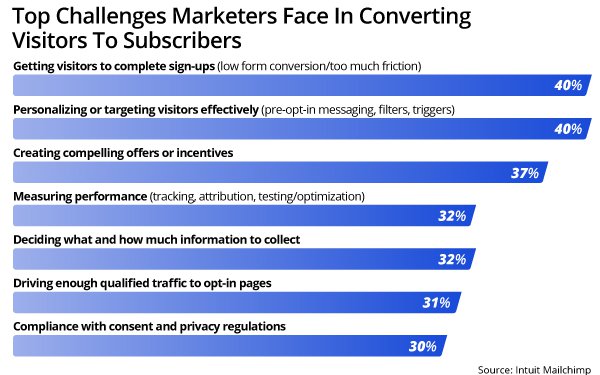
Still, marketers face these challenges:
- Getting visitors to complete sign-ups (low form conversion/too much friction)—40%
- Personalizing or targeting visitors effectively (pre-opt-in
messaging, filters, triggers)—40%
- Deciding what and how much information to collect—32%
- Driving enough qualified traffic to opt-in
pages—31%
- Compliance with consent and privacy regulations—30%
“This research reinforces what marketers are feeling every day: Relevance
comes from clarity, not volume,” says Diana Williams, vice president of product, Intuit Mailchimp. “When data is fragmented, even the best intentions fall short.”
The report
notes that “each interaction a consumer has before the opt-in influences how they feel about a brand and whether they decide to subscribe.” But are brands fully focused on this
imperative?
Marketers report these levels of pre-opt-in channel alignment:
- Highly aligned: messaging and timing are planned across
channels—33%
- Moderately aligned: Some channels are coordinated, but not all—56%
- Loosely aligned: Most channels operate independently with
occasional overlap—9%
- Not aligned: Each channel runs independently—2%
The most valuable channels for opt-in conversions are:
- Organic social—62% for email, 43% for SMS
- Paid social ads—58% for email, 40% for paid social ads—40%
- Google ads or other paid
search—41% for email, 35% for SMS
- Website or blog content—30% for email, 28% for SMS
- Influencer or partner content—16% for email, 9% for
SMS
- QR codes—12% for email, 0% for SMS
- Generative AI optimization—10% for email, 5% for SMS
Intuit and Ascend2 surveyed
6,192 consumers and 2,057 marketing professionals across the United States, Canada, the United Kingdom and Australia in October and November 2025.