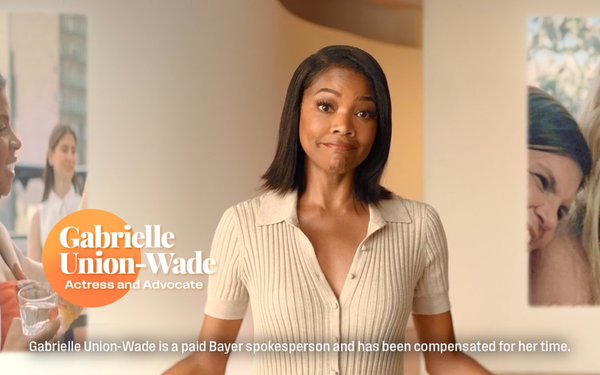
“Don’t sweat it. Lynkuet it,”
advises Bayer in a campaign for its new hormone-free menopause hot flash treatment, which launched in November and will run through 2026.
Titled “Life Doesn’t Stop for a Hot
Flash,” the campaign stars actress and Lynkuet user Gabrielle Union-Wade.
“I want to use my voice for things that matter,“ Wade-Union says to begin a :75 spot running on streaming services (including Prime Video, Netflix, Peacock, Disney and Paramount)and digital. Campaign
video activations are also planned around the upcoming Winter Olympics, the brand tells Marketing Daily.
“Women deserve to know that there are treatment options for moderate to
severe hot flashes,” Wade-Union continues, adding that Lynkuet “reduces the number and severity of hot flashes day and night, with some women having fewer hot flashes as early as one
week."
advertisement
advertisement
The campaign is targeted to both women 40+ and healthcare providers (HCPs), Amy Hessels, Bayer’s vice president, women’s healthcare marketing, tells Marketing Daily.
By “showing up as one brand” to both audiences, she explains, the campaign could “create a shared language between HCPs and the women coming into their offices. By both groups
hearing and seeing the same creative and message variations, they are able to move the care conversation, information and education-sharing forward.”
Lynkuet is a key piece of
a resurgence in Bayer’s pharmaceutical business, its pharma division president Stefan Oelrich told the J.P. Morgan Healthcare Conference last month. One slide in his presentation said the
medication was “driving our next wave of growth."
The slide stated that Lynkuet is “addressing a high unmet need”: around 1.3 million women enter menopause transition
annually in the U.S., with about 80% of then experiencing hot flashes, but two-thirds of the women don't choose or are not eligible for hormone therapy.
Doctors “take a big focus”
on this area, Oelrich said, which when added to Bayer’s “100 years of leadership in women’s health…makes this a very attractive opportunity with a blockbuster
profile.”
But, he cautioned, “a common mistake is to think, this is so big an opportunity that's easy to win. We need to be very clear on getting to the right segments that are
really in need of this… so we're doing a lot of educating right now.”
Not only are many doctors entrenched In prescribing hormone therapy “because they've been doing that
for so, so many years,” he explained, but “they need to understand that sometimes the need of the woman is not necessarily what the doctor wants.”
Furthermore, he noted,
“the majority in this country of women that get hormone replacement therapies still get [Pfizer’s] Premarin or Prempro. These are therapies that were invented in the '50s, made out of
horse urine.
“I think we have something better to offer, at least to give some choices there. Women deserve to have those choices, and we're offering [them].”