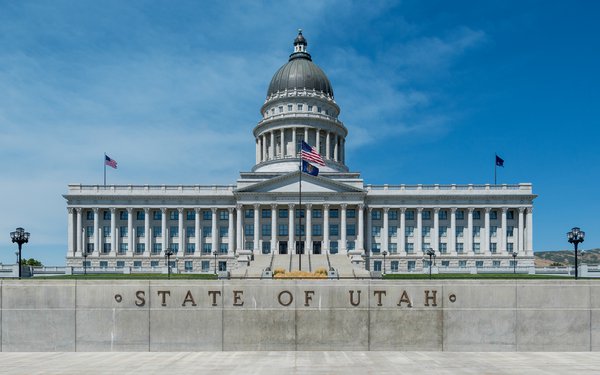
The tech industry on Thursday sued
to prevent Utah from enforcing a law requiring app distributors like Google and Apple to verify users' ages and then block minors under 18 from downloading apps without parental permission.
The App Store Accountability Act unconstitutionally "imposes a broad censorship regime on mobile apps," the
Computer & Communications Industry Association argues in a complaint filed in U.S. District Court in Utah.
"Our Constitution forbids laws that require businesses to 'card' people before they can enter bookstores and community theaters," the group writes. "And the First Amendment prohibits
such oppressive laws as much in cyberspace as it does in the physical world."
advertisement
advertisement
Utah passed the law in March 2025, and the key provisions are slated to take effect
this May.
The Computer & Communications Industry Association -- which represents companies including Amazon, Google and Meta -- argues that the age verification and
parental consent requirement violate developers' First Amendment rights to distribute lawful speech.
"For example, a 14-year-old cannot purchase the audiobook version of The
Giver from Audible until her parent or guardian approves the purchase," the group writes. "If her parent or guardian is too busy or refuses to approve the request, or cannot adequately prove legal
authority, the minor would be blocked entirely from listening to the John Newbery Medal-winning novel."
The organization adds that the age verification requirements also
infringe users' First Amendment rights.
"Verification methods generally ask users to upload a government-issued ID, such as a driver’s license or passport, or input
credit card information," the group writes.
"This will, at best, deter users (many of whom do not wish to disclose this type of sensitive information to app stores) from
accessing the tremendous amount of expressive and informational offerings within the app stores and from engaging in the protected speech and knowledge-seeking they facilitate," the tech industry
organization adds.
The group is seeking to block enforcement of the law's key provisions.
Texas and Louisiana have both passed similar statutes, and
federal lawmakers have introduced comparable national legislation.
The Computer & Communications Industry Association and the student group Students Engaged in Advancing
Texas sued over that state's law, and late last year obtained an
injunction blocking enforcement.
U.S. District Court Judge Robert Pitman in Austin ruled in that matter that the Texas statute may have "some compelling applications," but
is too broad to be constitutional.
For instance, he wrote, "nothing suggests Texas’s interest in preventing minors from accessing a wide variety of apps that foster
protected speech (such as the Associated Press, the Wall Street Journal, Substack, or Sports Illustrated) is compelling."
Pitman also found that Attorney General Ken Paxton --
who opposed the injunction -- failed to "cite evidence to substantiate the assertion that downloading an app of any kind without parental permission poses a health hazard to minors."
Texas has appealed the ruling to the 5th Circuit Court of Appeals.