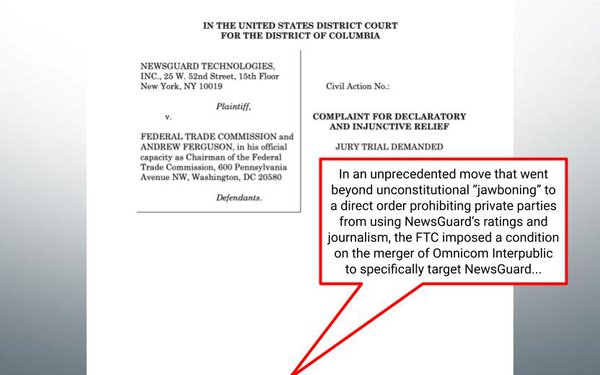
The Federal
Trade Commission violated the First Amendment by prohibiting Omnicom from contracting with news ratings services as a condition of its merger with Interpublic Group, NewsGuard claims in a lawsuit
filed Friday.
The FTC "is brazenly using its power not for any issue concerning trade or commerce, but rather to censor speech," NewsGuard, which rates news sites for
reliability, alleges in its complaint, filed in federal
court in Washington, D.C.
"It has done so simply out of disagreement with NewsGuard’s First Amendment-protected journalistic judgments about the reliability of news
sources," the company adds.
advertisement
advertisement
Court TV founder Steven Brill and Wall Street Journal former publisher Gordon Crovitz launched NewsGuard six years ago to help
people spot fake news online. At launch, the company was backed by investors led by Publicis Groupe.
NewsGuard is now
challenging both the Omnicom merger order, as well as a separate demand by the
FTC for a trove of NewsGuard documents -- including all reporters' notes, subscriber lists, memos, emails and texts and other material. NewsGuard also recently petitioned the FTC to vacate that demand for
information.
The FTC has not yet acted on that petition.
"In a multi-faceted campaign extending almost a year, the Chairman and the FTC have used the Commission’s
considerable regulatory powers to attack and punish a private news organization ... to impose their view of speech nirvana," the company writes.
"The FTC has pursued its
campaign because Chairman [Andrew] Ferguson does not like NewsGuard’s news ratings, which he views as biased against conservative publications," NewsGuard adds. "That is wrong --
NewsGuard’s ratings and journalism about news sources are non-partisan and based on fully disclosed journalistic criteria. But the FTC’s actions are plainly unconstitutional even if that
were not the case."
Among other allegations, NewsGuard says a key provision of the FTC's order approving Omnicom's merger with Interpublic "amounts to a
government-imposed blacklist."
The merger order specifically prevents Omnicom from directing ad buys based on media companies' "adherence to journalistic standards or ethics
established or set by a third party."
That provision "prohibits Omnicom and its ad agencies and affiliates from using NewsGuard’s services," NewsGuard writes.
"Other agencies and companies seeking to use NewsGuard’s ratings and services also face the prospect of FTC investigations, enforcement actions, and liability if they do not
divorce themselves from dealings with NewsGuard," the company continues.
NewsGuard adds that the order has already harmed its business.
"In addition to
the direct restrictions imposed on Omnicom and its affiliates, other NewsGuard clients have been scared away by the FTC’s actions," NewsGuard alleges, adding that one "long-time client" that did
"significant business" with Omnicom and Interpublic "indicated it would not renew its contract ... noting 'recent developments that require us to take a more cautious approach to this area of our
business.'"
NewsGuard -- which is represented by the free speech advocacy group Foundation for Individual Rights and Expression -- claims that Ferguson has "been a long-time
critic of NewsGuard," adding that before he was appointed FTC chairman he "promoted an ideologically motivated effort to pursue and censor NewsGuard."
The complaint notes that
Ferguson tweeted in November 2024 that NewsGuard “led collusive ad-boycotts -- possibly in violation of our antitrust
laws -- to censor the speech of conservative and independent media in the United States.”
The ratings service also points out that Ferguson stated in 2024 that NewsGuard “seems to give a free pass" to major left-leaning outlets.
NewsGuard says it has always been nonpartisan and bases ratings "on fully disclosed criteria focusing on long-standing journalistic standards."
"Many
left-leaning outlets receive lower scores than comparable right-leaning sources (e.g., Fox News scores higher than MSNBC, the conservative Washington Examiner outscores the liberal Daily Beast, and
the conservative Daily Caller outscores the liberal Daily Kos)," the company writes.
NewsGuard adds that Ferguson's "censorship" accusations against NewsGuard have "inverted
the relationship between the government and the First Amendment."
"NewsGuard is a private business that offers assessments of the quality of news sites based on disclosed journalistic
criteria," NewsGuard argues.
"As a matter of law, NewsGuard cannot be a censor," the ratings service adds. "But by asserting FTC control over the market for NewsGuard’s services,
Chairman Ferguson has embraced the censor’s role."
The company is seeking a judicial declaration that the FTC's demand for information, and the merger condition
prohibiting Omnicom from contracting with news ratings services, are unconstitutional.
NewsGuard is also asking to block the FTC from attempting to enforce both that merger
condition and its demand for information.
NewsGuard isn't the only company battling the FTC over alleged First Amendment violations. The agency also attempted to subpoena
extensive information from the watchdog Media Matters for America, which published a report about neo-Nazi content on the social platform X.
Last year, Media Matters sued the
FTC over its demand and obtained an injunction blocking the agency
from pursuing its demand.
The FTC has appealed that order, arguing that it's investigating a potential conspiracy to withhold online advertising "from certain disfavored
media."