Telling the difference between premium
streamers isn’t easy for media consumers.
And while “exclusive original” programming would seem to be the main differentiator, “consumers struggle to identify
meaningful differences when it comes to value, usability or distinct content offerings,” says Hub Entertainment Research.
When asked to identify the top original programming with its
premium streamer platform, only one got to 50% level correctly with its streamer association when surveyed by respondents: Netflix’s popular “Squid Game.” Another 34% didn’t
know where “Squid Game” played, and 16% made an incorrect match.
HBO Max’s “Game of Thrones” was next with a 40% score for correctly identifying the streamer,
followed by Paramount+'s “Landman” at 30%, HBO Max’s “The Pitt” at 23% and HBO Max's “The White Lotus” with 22%.
advertisement
advertisement
Only 17% of respondents could
correctly identify “Severance” with Apple TV and “High Potential” on Hulu/Disney+.
Roughly 30% of the time respondents made incorrect guesses in efforts to match major
popular shows and their platforms, while 40% to 60% admitted they did not know at all.
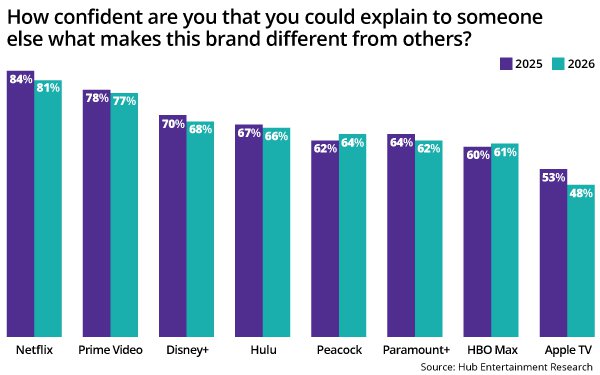
Still, more broadly, respondents generally feel they can explain why one branded streamer differs from
others.
Top scores here go to Netflix at 81%, followed by Prime Video (77%); and Disney+ (68%). Next best go to Hulu (66%) and Peacock (64%).
Branding changes are also coming to
YouTube -- a growing competitor to premium streaming platforms -- especially young audiences.
According to 16-34 year old respondents, 32% characterize the Google-owned platform as “more
of a TV network/streaming platform”. Another 32% say it is equally a TV network/streamer and a creator/social video platform.
Even older 35 plus audiences are seeing a change, with 36%
of those consumers saying YouTube is equally a TV network/streamer as well as a creator/social video platform.