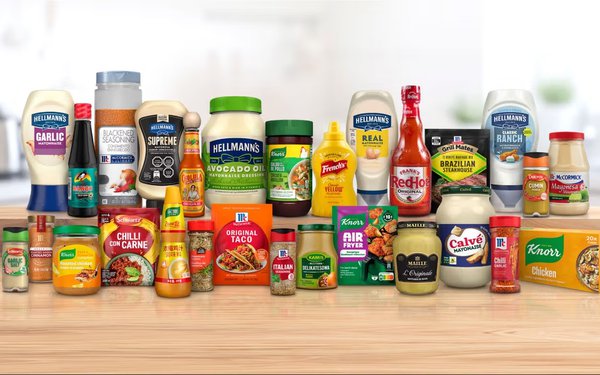
It's official. Unilever and McCormick & Co. have
agreed to a merger that will create a $65 billion food giant. The deal calls for combining Unilever's massive food portfolio, which includes brand names like Hellmann's, Knorr and Marmite, with
McCormick's spice and seasonings offerings, operating under the McCormick name. Unilever and its shareholders will receive $15.7 billion in cash and 65% of the new company's outstanding equity —
a structure that achieves a goal management says will pay off in the long run: establishing Unilever as a "pure play" health and personal care company, focusing on brands like Dove and Axe.
Unilever has already spun off its ice cream brands, now the stand-alone Magnum Ice Cream Company, which includes Magnum,
Cornetto and Ben & Jerry's.
advertisement
advertisement
But following a year of massive restructuring among major food conglomerates, the
Unilever/McCormick move had industry observers scrambling to keep up, as many CPG leaders ditched their generational commitment to vast conglomerates, finding new ways to prune their portfolios. Those
deals have included the breakup of Kellogg in 2023, the resulting acquisition of Kellanova by Mars in 2025, and the Ferrero acquisition of WK Kellogg in 2025. And Kraft Heinz, which announced a plan
to split into two companies in September 2025, reversed course in February, with its new CEO declaring the company's challenges "fixable" and committing $600 million to a turnaround instead.
While rumors of the deal got favorable reactions when reports surfaced last week, the market has cooled to the idea, with
shares of both companies falling after the announcement. But much can happen to distract investors in a week, especially given world events. Separately, Unilever announced a global hiring freeze at
all levels for at least three months, citing the economic challenges posed by the U.S.-Iran war and soaring energy costs.
Writing before the deal was announced, Steve Powers, an analyst who covers CPG for Deutsche Bank, called the deal "potentially transformative" for McCormick's shareholders. "The
strategic fit is theoretically strong, combining Unilever's leadership in bouillons and mayonnaise with MKC's strength in spices, seasonings, and hot sauce."
McCormick's announcement touted the deal as a response to the growing consumer demand for more exciting foods. "This transformative combination accelerates
McCormick's strategy and reinforces our continued focus on flavor," said Brendan Foley, McCormick's chairman, president and CEO, in the announcement. "Together, we will be better positioned to
accelerate growth in attractive categories."
It's a complicated deal, which will give Unilever and its
shareholders 65% ownership of the combined company's outstanding equity, equivalent to $29.1 billion, as well as $15.7 billion in cash. The calculations value Unilever Foods at $44.8 billion, and
McCormick at $21 billion.
The deal not only frees Unilever from its food portfolio, giving it a majority stake in
the new combined entity, but it also allows the Dutch company to focus on health and personal care, which it believes can grow faster than food. "This transaction is another decisive step in
sharpening our portfolio and accelerating our strategy towards high-growth categories," said Fernando Fernández, Unilever's CEO, in the announcement. "We are unlocking trapped value through a
growth-led separation of Foods, creating a scaled, global flavor powerhouse."
The merger is expected to close in
mid-2027.