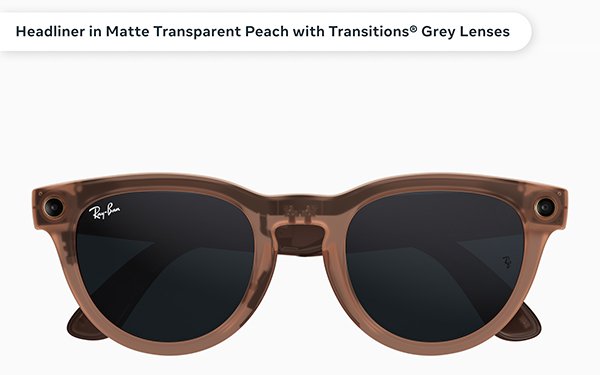
Following early reports, Meta has officially announced style and functionality details
for its forthcoming EssilorLuxottica AI smart glasses as well as software updates, including neural handwriting on Display models, as Apple, Google and Snapchat develop competing AR wearables.
First, Meta’s announcement confirms earlier reports regarding the release of its upcoming second
generation “Ray-Ban Blayzer Optics” and “Ray-Ban Scriber Optics” being sold at optical retailers with prescription lenses in mind.
Both smart glasses models –
starting at $499 – will become available in the U.S. and select international markets starting April 14 and are designed to be worn as “all-day eyewear,” with adjustable features
such as interchangeable nose pads, temple tips and overextension hinges.
advertisement
advertisement
In line with its upcoming prescription-first offerings, Meta is developing tech designed to target a wider range of
niche communities and capabilities.
For example, the company is currently working on nutrition tracking spurred by voice prompts and photos, allowing health-conscious consumers to track what
they eat hands-free with Meta AI logging key nutritional details to the user's food log.
Over time, Meta wants its chatbot and AI systems to deliver more useful automated insights based on a
user's personal food log history.
Smart glasses users will also soon be able to ask Meta AI to summarize their WhatsApp messages and ask for specific details mined from their conversations
within the app.
Despite unexpected pauses to the planned
international expansion of its Ray-Ban Display glasses in January due to “extremely limited inventory,” Meta’s announcement includes new features for its Display model.
In
the coming weeks, users with Display smart glasses will be able to write with their finger on any surface to reply to messages on Instagram, WhatsApp, Messenger and iMessage – a feature called
Neural Handwriting.
With enhanced social functionality in mind, Display users will also soon be invited to view and share automated videos compiled of in-lens display interactions, their POV
of the world around them, and audio.
As Meta readies these updates, other tech companies are developing their own competing AI wearables, with next generation models from Google, Apple, and
Snapchat expected to enter the consumer hardware market by the end of 2026 or early 2027.
Google and Samsung are set to release two different Android-powered AI smart glasses sometime this
year in collaboration with Warby Parker, and Apple is developing smart glasses with vocal Siri functionality, while Snapchat is attempting to beat all competing companies to market with an earlier release of a new-gen AR Spectacles
product.
In 2025, however, Meta smart glasses made up about 73% of the total market, with sales tripling year-over-year.