There is a conversation happening in
every major marketing department in America, and it goes something like this: Is sports sponsorship really about sports? Or is it simply the last place where you can buy a genuinely captive
audience?
It’s an argument Mario Artesiano, AT&T's director of sponsorships, has heard before. And while he doesn’t disagree, exactly, he thinks it misses a bigger point, which
explains the brand’s long-term commitment to the NCAA’s March Madness tournament.
“It always offers something different, and it’s the best unscripted drama you can
get,” he tells Marketing Daily. “The storylines change constantly.” This year was an especially good example, with the University of Michigan defeating the University of
Connecticut to end a 37-year title drought in the National Championship Game. That event averaged 18.3 million viewers, says the NCAA, making it the most-watched Championship Game since 2019, and the
most-watched National Championship Game ever on TNT Sports.
advertisement
advertisement
National TV ad spending for the tournament's first weekend reached $499 million, a 5% increase over the prior year. Perhaps more
telling? MediaPost reports that the average attention index for tournament ads was 119, indicating that ad messaging during March Madness performed 19% better than the TV industry average.
AT&T packed plenty into this year’s March Madness footprint. The brand launched a new campaign starring Ted, an all-around spokesperson, in numerous ads promoting ways people can
“connect better.” Six national spots featuring Karl-Anthony Towns, Jalen Brunson, Candace Parker, Jayson Tatum, and others ran across CBS, TBS, TNT, TruTV, and ESPN. The
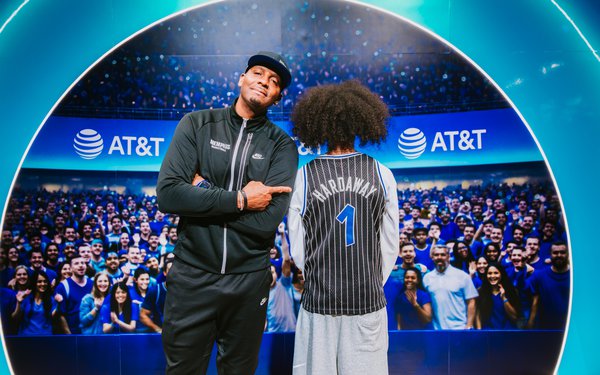
brand owned the CBS Bracket Manager, sponsored the Las Vegas Sphere, headlined its Friday night block party with Twenty One Pilots, and activated at fan festivals for both the men's and women's Final
Fours.
And with two teams in the final four within driving distance from Indianapolis, Artesiano AT&T's on-site activations had the kind of genuine energy needed for peak fan
engagement.
Artesiano's verdict: Everything paid off. "Overall, this year went really, really well," he says. The Fab Five altcast during the Michigan-Arizona semifinal, which trended on
social media throughout the game and delivered the most-watched altcast on TNT Sports in eight years, is a useful illustration: The tournament keeps finding new ways to generate moments. At this
point, it isn't an experiment for AT&T; it's a platform the brand knows how to use.
As for how you know when it stops working: impressions, yes, but also brand love scores, willingness to
recommend, and message retention. Significant dips in any of those would trigger a reallocation conversation, Artesiano says, but for now, that isn’t happening.
March Madness is what he
calls "a cultural moment alongside a sporting moment" — one of the few properties that pulls in people who don't otherwise watch basketball.
This year, those stakes delivered. For a
brand whose entire message is about connection, there are worse places to spend a month.