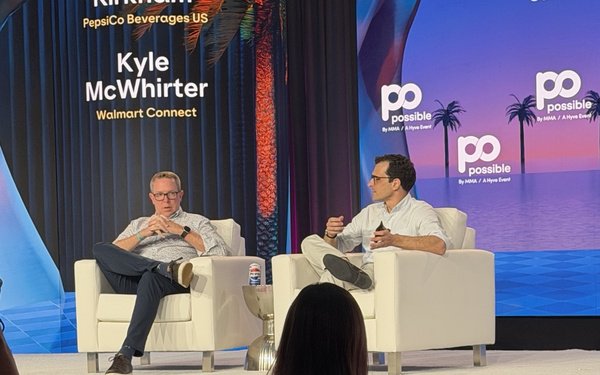
Mark Kirkham, PepsiCo Beverages US,
left, and Kyle McWhirter, Walmart Connect, speaking on one of the many stages at POSSIBLE. (Photo: Rob Williams)
MIAMI BEACH, FL – PepsiCo is using retail media for more than
lower-funnel conversion.
At POSSIBLE in Miami Beach, Mark Kirkham, chief marketing officer for PepsiCo Beverages North America, said Walmart Connect helped the company rethink
how it launched a new prebiotic cola, using shopper signals to shape targeting, creative, pricing and broader go-to-market planning.
“I’m not a big fan of
the term retail media network,” Kirkham said during a session with Kyle McWhirter, group director and head of food at Walmart Connect. “It’s more than that. It’s a shopper
engagement network.”
advertisement
advertisement
The case centered on PepsiCo’s prebiotic cola launch following its acquisition of Poppi. Kirkham said PepsiCo first tested the product
through a Black Friday launch with Walmart and other partners, selling out in less than 24 hours. The early e-commerce test helped PepsiCo gather data before a broader retail rollout in
February.
That learning changed the launch plan. Kirkham said Walmart shopper signals helped PepsiCo adjust messaging, targeting, pricing architecture and retail sell-in
strategy. One surprise was that taste, rather than functional prebiotic benefits, proved to be a stronger lead message for many consumers.
“What we learned was
that great Pepsi taste was ultimately what was driving people in,” McWhirter said.
PepsiCo responded by changing creative on the fly. Kirkham said the company
developed assets in-house and used dynamic creative to vary messages around taste, no artificial ingredients and prebiotic benefits for different audiences.
“Dynamic creative is kind of an overused term,” Kirkham said. “If you can act, it is what you can react to.”
For media buyers,
the significance is that Walmart Connect’s data did not stay confined to Walmart. Kirkham said PepsiCo applied learnings from Walmart shoppers to national programs across other retailers, using
e-commerce signals to inform broader media and retail strategy.
“This project started omnichannel first,” Kirkham said. “We took the learning from
Walmart Connect and the Walmart shopper and applied that to our national programs across all retailers.”
McWhirter said the program showed how retail media is
moving beyond impressions, CPMs and return on advertising spend toward business outcomes such as velocity and household penetration.
For PepsiCo, the approach also
changed internal habits. Kirkham said the company had historically been more linear in how it launched products, relying on large national campaigns and traditional retail materials. The new model
required more flexibility by channel, message and audience.
“The days of just launching big, spray and pray, one big national launch, I’m not saying
we’re not going to do that. We’re Pepsi,” Kirkham said. “But as an industry, our ability to be flexible by channel, working with partners early and understanding what’s
working, that’s what’s making a difference.”
Kirkham said the broader lesson for brands is to stop treating media, retail and innovation as separate
transactions.
“Don’t be transactional,” he said. “Media used to be a transaction. Retail sales definitely was very transactional. Innovation used
to be a way to stack cases.”
The shift, he said, is toward earlier data sharing, joint planning and co-creation among brands and retailers.
For media buyers, that means retail media is no longer just a checkout tactic. In PepsiCo’s telling, it is becoming a product-launch intelligence system -- one that can
help brands decide who to target, what to say and where to invest before a campaign scales.