Omnicom has gone from
testing agentic media buys via its homegrown OMNI platform to deploying it as part of its routine media buys for certain clients, and facilitating more direct deals with publishers and compressing the
media supply chain by reducing the “messy middle,” the holding company’s top executives told Wall Street analysts during its first-quarter earnings call late Tuesday.
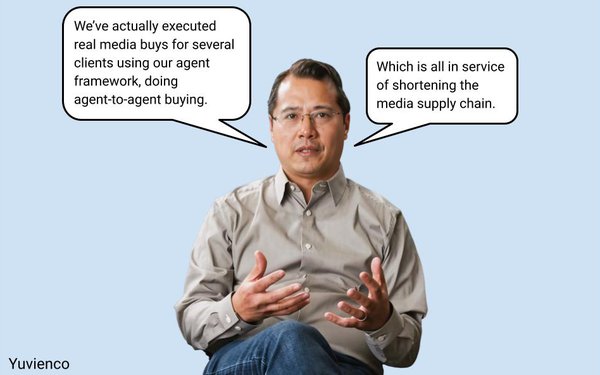
“We’ve already tested the pipes and have been able to have money flow through to actually buy inventory available on certain publishers,” CTO Paolo Yuvienco said, noting
that Omnicom was “first-to-market” with the industry’s fledgling AdCP agentic media-buying protocol and has been helping to define and evolve it.
“Since then,
we’ve actually executed real media buys for several clients using our agent framework, doing agent-to-agent buying,” he confirmed, adding, “which is all in service of shortening the
media supply chain.”
advertisement
advertisement
That burgeoning agentic media-buying process has also been fueled by Omnicom’s integration of its proprietary consumer identity data platform Acxiom,
which Omnicom acquired as part of its acquisition of Interpublic late last year, and Yuvienco described it as “exponentially powering” more effective and efficient media buys for
Omnicom’s clients.
In response to an analyst’s question, Omnicom CEO John Wren said the agentic media-buying process was generating better media pricing for its clients
and also making buys more efficient by facilitating more direct buys with publishers, reducing ad-tech middlemen, and increasing the amount of working media dollars.
Less clear was
how Omnicom executives addressed how these changes were impacting its role as a “principal” media buyer in terms of increasing the holding company’s margins on media buying, but Wren
said, “The whole environment expands and we will be rewarded as a result of that.”
Regarding the integration of Acxiom’s proprietary consumer database, Wren noted
that Interpublic paid $2 billion when it won a holding company bidding war for it back in 2018.
“Five years later, I paid $9 billion for all of Interpublic,” he noted,
adding: “I think my waiting paid off from an economic point of view.”