Advertisers saw a shift in focus away from traditional
smartphone hardware and toward agentic artificial intelligence, as Google executives spoke at the Google I/O 2026 Developer Conference about an overhauled Gemini ecosystem and updates to artificial
intelligence.
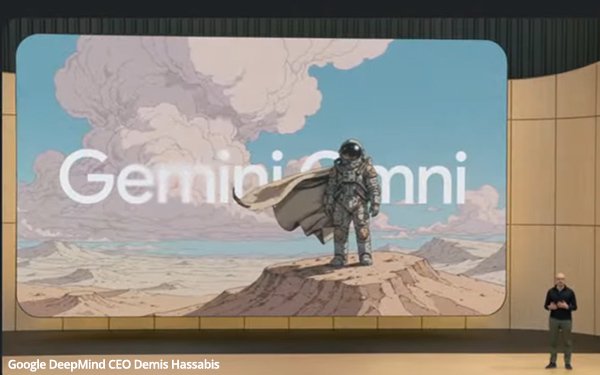
Google DeepMind CEO Demis Hassabis on Tuesday announced “Gemini Omni Flash," the company's first in a new family of models designed to collapse video, image, and audio
generation into one system.
"It can translate complex ideas into interactive videos," Hassabis said, adding that the videos can be edited through conversational language.
“Gemini Omni Flash" is designed to unify the operating layer across text, audio, images, and high-fidelity video. Rather than traditional generate-and-download workflows, it integrates
directly into the Gemini ecosystem to treat all media types as creative context.
advertisement
advertisement
Developers, creators and advertisers can now find the video-first generative model in the Gemini app, Flow by
Google, and YouTube Shorts, with API access expected in the coming weeks.
“Gemini Omni Flash” changes the economics, speed, and the creative strategy of advertising. By unifying
text, image, and video generation into a single, native pipeline, it removes the friction traditionally found in production, translation, and local campaigns.
It starts with video, but also
provides tighter integration with tools like Google Lens, which allows consumers to take a screenshot of a video ad and find where to purchase the exact product variations shown.
Omni ties
into advertising by transforming video commercials from passive entertainment into clickable, data-driven storefronts
Prior platforms ran as two different architectures, with Veo for video,
and a separate system for image generation, Hassabis explained. Omni collapses those processes through the technology stack by combining Gemini’s intelligence with Google’s generative
media systems for creation across modalities from one model.