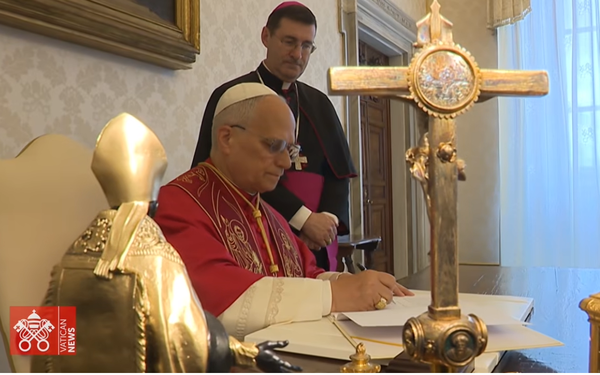
Pope Leo XIV released the pontiff's first encyclical on Monday, a
document that outlined the critical importance of human dignity and morality in the era of artificial intelligence (AI).
But the release of the encyclical revealed an unusual collaboration
between the Vatican and Anthropic, a Silicon Valley AI start-up whose co-founder Christopher Olah joined Pope Leo and leading theologians on a Vatican panel.
Anthropic, which employs an
in-house philosopher to help introduce morality into its AI, has dabbled with philosophical debate around whether its models experience
consciousness.
The Pope invited Olah to speak at the presentation of the encyclical in the Vatican City in an effort to broaden the conversation on the important questions raised by AI. Perhaps the Pope found AI a worthy topic based on his training
as a mathematician.
advertisement
advertisement
The Pope, born Robert Francis Prevost, earned a Bachelor of Science (BS) degree in mathematics from Villanova University in 1977 and taught physics and math at St. Rita of
Cascia High School.
Reports suggest Olah was chosen because of his focus on AI safety, as well as engagement with religious communities. Anthropic also has a reputation for developing AI
models based on ethics that align with the Pope's initiative to safeguard human dignity.
“I want to begin with something that may sound strange coming from the co-founder of an AI
company — and someone who chose this work out of a desire to help things go well for humankind,” Olah wrote in his speech, published on Anthropic's website.
He continued: “That is why, if we want this technology to go well,
it is enormously important that there be people outside those incentives — people who care about things going well and insist on safety, who are paying close attention, who are willing to say
hard things, who are willing to be our earnest, thoughtful, critics. It is through dialogue and mutual effort, through the push and pull, that humanity will achieve great things.”
Olah
expressed his gratitude to His Holiness and the church to take up this work. In the past, he wrote about the importance of Claude,
Anthropic's AI model, becoming more ethical.
“To disarm means discrediting the assumption that technical power automatically confers the right to govern,” the pope said Monday in
his new encyclical to the faithful. “To disarm does not mean rejecting technology, but preventing it from dominating humanity.”
The encyclical, which was inspired by the church’s
thinking about what it means to be human, draws on 2,000 years of moral and social teachings. The timing of the document was "symbolic," according to
The National Catholic Reporter."It was signed on the 135th anniversary of
Pope Leo XIII’s 1891 Rerum Novarum, which protected workers' rights during the Industrial Revolution," according to the media outlet.
From the Pope, the document — Magnifica humanitas, released Monday — means "magnificent humanity" in Latin. It marks the Pontiff’s most consequential act since becoming the
spiritual leader of the world’s 1.4 billion Catholics one year ago.
Encyclicals present a way for a pope to provide moral guidance on the greatest challenges of their times. This Pope
has chosen artificial intelligence and how it will impact humanity. But the most intriguing part is his decision to present it with Olah.
Olah welcomed the Pope's words. He wrote in his
presentation that "we dwell so often on what divides us, but humanity, full of dignity and conscience, has so much common ground."
In conversations at Anthropic, executives have found shared
and deeply held convictions about AI.
"Some might believe that matters of AI are best handled by computer scientists like myself," Olah wrote. "They are mistaken: the questions raised by AI
are bigger than the AI research community, not just in their implications, but also in their nature."
AI systems are not engineered the way a bridge or an airplane is engineered. People
understand an airplane because they have designed every part of it and understand the physics that act on it.
AI models are grown and structured after the brain, Olah wrote, adding that AI is
made from humans, from human words, and they remain important in ways that are mysterious to even those who train them, according to his vision.
The machinery that makes this possible is
the work of math and programming and science, but the characters chosen, how it interacts with the world, and how it should interact with the world are things more clearly questioned for humanity,
religion, philosophy, and society, Olah wrote.
In the speech, Olah asked "religious communities, civil society, scholars, governments, and all people of good will — to do what His
Holiness has done here: to take this seriously, to look closely, and to push events in a better direction."
He added: "We need informed critics who will tell the labs when we are failing. We
need moral voices that the incentives cannot bend."