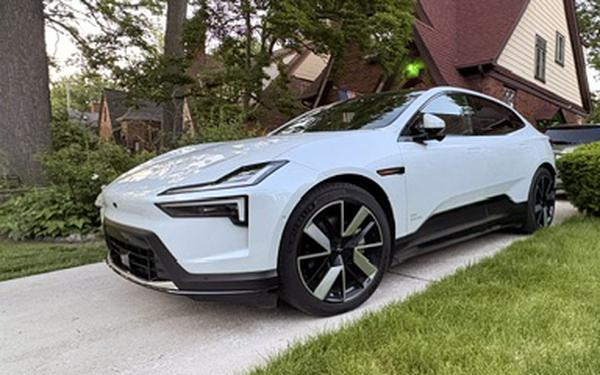
The Polestar 4 is like no other
vehicle most consumers have ever seen.
The high-performance electric SUV coupe is distinguished by the complete elimination of the rear window, replaced entirely by a
high-definition roof camera and digital rearview mirror. This design choice opens up a uniquely spacious, lounge-like rear seat featuring an expansive, full-length electrochromic glass roof.
The video rearview mirror has been offered by other automakers in the past and can be turned off to reveal a regular mirror. But in this case, it’s not just a party trick —
there is no rear window, so the video monitor is the only way to see behind the vehicle.
While I’m usually not a huge fan of these video monitors because they give me a
little bit of vertigo, I got used to this one pretty quickly. During the day, it functions great. I have to detract points for night use because it looks like you are driving in pouring rain, and
it’s really hard to make out the vehicles behind you. I cleaned off the lens of the video camera, but it didn’t improve the view.
advertisement
advertisement
I still give Polestar —
which is a sibling of Volvo (both companies share the same parent corporation, the Chinese automotive conglomerate Geely Holding Group) — props for pushing the envelope.
I love it when an automaker takes a chance and does something dramatically different from a design standpoint. I was a dissenting voice in giving General Motors props for the Pontiac Aztek.
While many of my colleagues and the public declared it ugly, I thought it took guts for GM to offer up something so out-of-character for the normally conservative automaker.
Polestar posted a video about the design choice: “First seen on American racetracks at the turn of the 20th century, the
traditional rearview mirror has been a mainstay in car design for the best part of 100 years. But more than a century after its introduction, little has changed. Until now. The rise of digital
rearview mirrors has enabled car designers to upend a century of automotive history.”
Polestar also shared a
video about the four key design features that help the car go faster. I’ve loved flush door handles on every vehicle since they first came out a few years ago. If they help with
aerodynamics, that’s a bonus. They also look cool when they pop out upon your approach.
The Polestar doesn’t need much help in the speed department. The dual
electric motor in my test vehicle resulted in 544 hp and 506 lb.-ft. of torque.
The all-wheel-drive vehicle has 280 miles of range with a full charge. The average range of EVs at
full charge is around 300, according to Coltura, an EV advocacy group. For most drivers, 280 miles is plenty. I only found myself at a
Level 3 fast charger once over the course of the week, and it was really by choice — I wanted a smoothie and there happens to be a fast charger at one near my house.
In
order to get the word out about the unique vehicle and all of its attributes, Polestar internally created a beautifully photographed campaign themed “Clarity in Motion.”
“For this campaign, we leaned into more product-forward storytelling — not as a response to convention, but to align with how U.S. audiences often build connection: through
clarity around performance and experience,” according to Kim Bolan, Polestar’s director, content, social media and partnerships.
The campaign is expressed through three
pillars.
A video about performance details the vehicle’s instant acceleration, intelligent routing and adaptive
handling. Another video about innovation details the integrated Google Gemini, intuitive driver assist and rearview clarity in HD.
Finally, a third video about design discusses purposeful aerodynamics, refined sustainable materials and the dynamic electrochromic
roof.
The vehicle’s starting MSRP is $62,900.