Snap
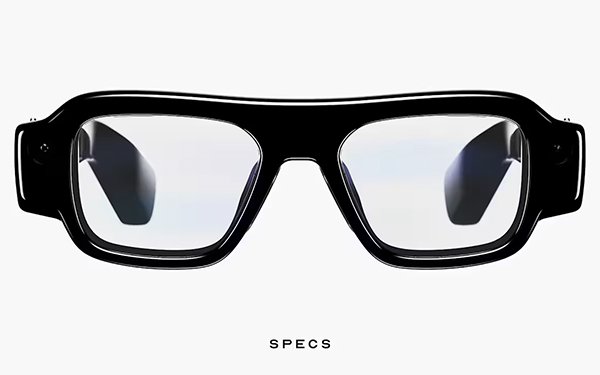
has officially unveiled its new generation of Specs, the social media company’s long-awaited augmented reality (AR) glasses designed to compete with wearables from Meta and Apple slated for next
year.
On Tuesday, Snap CEO Evan Spiegel presented the company’s new Specs product at Augmented World Expo
2026.
The AR glasses cost $2,195 with a $200 refundable deposit, marking a 15x price hike from Snap’s initial 2016 camera-only Spectacles model, which lost the company $40
million in unsold wearables.
In his presentation, Spiegel conveyed ideas similar to ones expressed by Meta CEO Mark
Zuckerberg -- stating that smartphones demand too much of our attention and will eventually be replaced by less intrusive smart glasses that can understand the surrounding world through “sight,
sound, movement, and context.”
advertisement
advertisement
“We believe the best technology fades into the background,
helping when it’s needed and getting out of the way when it’s not,” the company’s written announcement states, describing Specs as a “computer that fits into a pair of
glasses.”
“Almost 20 years since the launch of the iPhone, people are ready to think about computing differently,” Spiegel said in an
interview with CNBC.
Specs are wireless, relatively lightweight, and allow removable inserts to support various eye prescriptions. They are available in two sizes, including
a 47-mm model that weighs 132 grams, and a 52-mm model that weighs 136 grams.
The display system is powered by a
proprietary technology consisting of “liquid crystal on silicon,” delivering a 51-degree field of view and 16 million colors.
According to Snap, users will feel as if they
are viewing a 24-inch desktop monitor while working, or a 115-inch home cinema screen placed about 10 feet away while watching a movie.
Since the release of its
fifth generation Specs in 2024, the company has redesigned its waveguide technology to deliver a clearer view of the surrounding world.
“Our new waveguide uses billions of invisibly small nanostructures, so small that more than 10,000 can fit on the tip of a single hair,” the announcement
states, adding that Specs use the same tech found in the windows of Boeing 787 Dreamliner airplanes, allowing the electrochromic lenses to gently shift from clear to tinted in 10 seconds.
In September 2025, Spiegel shared an open letter describing Specs as a way for the company to overcome market challenges, writing that “Specs are how we move beyond the limits of smartphones, beyond
red-ocean competition, and into a once-in-a-generation transformation towards human-centered computing.”
Without a successful launch for the expensive
AR glasses, Snapchat’s revenue-boosting options may become more limited. The company is now attempting to court developers who want to publish Lenses built specifically for Specs.
Snap is rolling out agentic development tools for Specs Lenses in the Lens Studio via a developer preview in AI
code-editing softwares, including Claude Code, Codex, and Cursor. According to Snap, developers have already published “hundreds” of Specs Lenses.
Privacy concerns are a significant concern with this technology. Meta has faced legal issues following
allegations that its AI Smart Glasses collected X-rated user
video footage.
Snap says Specs users will be able to select the information they want to store, sync, share or delete.
To alert bystanders when Specs are recording, the AR glasses feature an LED light indicator that appears on the outer
frame.
Snap is planning to ship its AR Specs later this year across the U.S., the U.K., and France, with a
goal to beat competing tech giants to market.
Meta introduced its “Orion” AR glasses to the public in 2024, yet Orion wearables are still in development without a launch
date.