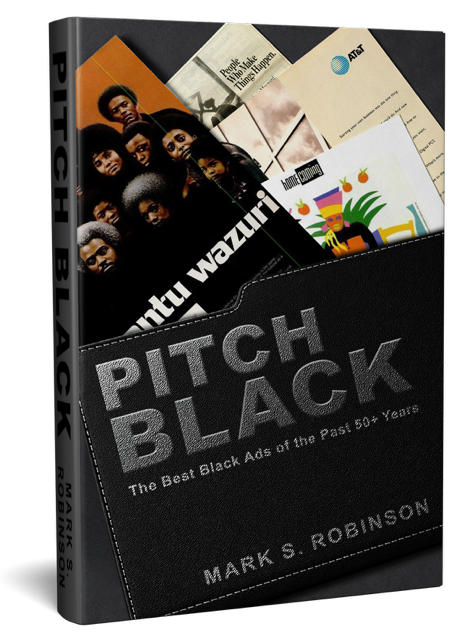
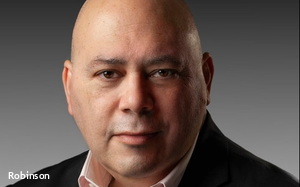
After retiring in 2023, Mark S. Robinson -- an ad exec
who spent 45 years working to make sure Black consumers had at least an occasional seat at the strategy table -- had a crushing realization. When he started trying to pull together a "best of"
compendium, "the process was a disaster. Those old ads aren't available. There is no archive. There is no collection, and no record that it ever happened."
Concerned, he made the writing of
"Pitch Black: The Best Black Ads of the Past 50+ Years," out in September, a group effort, recruiting friends and colleagues to zero in, decade by decade. He tells Marketing Daily what stood
out most as he finished the book.
This interview has been edited for length and clarity.
Marketing Daily: There are so many great ads I want to ask about, but let's start here: You describe a phenomenon you
call "there goes the neighborhood" — where increased diversity in an ad gets perceived by mainstream audiences as minorities "taking over" the message. Where does that come from, and what can
marketers actually do about it?
advertisement
advertisement
Robinson: Yes, it describes a social and cultural phenomenon, where minorities
may account for about 25% or 30% of the representation in an ad, and it becomes a "Black ad" or a "Hispanic ad." That's the whole DEI conversation today, in one nugget: that somehow, just the
inclusion of Black people in an ad makes white people feel uncomfortable, and that therefore, ads shouldn't do that. No one ever told white people they shouldn't make Black people feel
uncomfortable.
Marketing Daily: You also recount something Nat King Cole said, after his show lost sponsors,
that "Madison Avenue is afraid of the dark." Sixty-plus years later, has that fear actually gone away?
Robinson: Not nearly as much as one might expect. There's greater awareness, greater conversation -- but not much systemic change in agency leadership. There are
more minorities in advertising today than 50 years ago, but that's because there are minority-owned agencies, not because mainstream agencies hire them.
Marketing Daily: The KFC "We do chicken right" campaign is a fascinating case -- a 1980s Black agency's line that mainstream America absorbed. Why did
that one matter so much?
Robinson: The saying came from black-owned ad agency Mingo-Jones, and the "we"
is an implied association between KFC and Black people, suggesting that they shared a common understanding of the "right" way to cook delicious fried chicken, "a Black thing" that KFC learned how to
do.
The advertising message was a specific reassurance to Black consumers that the fried chicken served and sold by KFC would not disappoint them. It ran for more than a decade, and was so
successful that KFC told Young & Rubicam to use it in mainstream advertising. But then, it connects back to the earlier era, when Black people were often used as props in advertising -- Aunt
Jemima, the maids and butlers -- a device to signal you could afford to seem affluent.
With KFC, it became: You could have chicken made by Black people, chicken that tasted like what you
remembered from a cook in your kitchen. There's a dotted line connecting one era to the other, and a collective memory that gets triggered by that.
Marketing Daily: You include some terrible gaffes, too, including the Toyota Corolla ad that ran in Jet by "accident," headlined, "Unlike your last
boyfriend, it goes to work in the morning" and that infamous Pepsi/Kendall Jenner ad from 2017. Why do they keep happening?
Robinson: I've written a previous book that noted Black advertising professionals are invisible -- they don't see us when we're there, and they don't know we're not
there when we're not there. So many of these gaffes happen because we're not in the room, and nobody notices the absence.
Nobody notices there's a strategic deficit in their thinking because
of who's missing. If they had more diverse representation in the creative process, they'd avoid [problematic campaigns] in the first place.
Marketing Daily: You detail how William
Coors' comments sparked an NAACP boycott in 1984 -- and how Coors' response was to fund some of the most effective community-relations advertising of that era. Why include that story?
Robinson: It's ironic. Some of the worst offenders end up producing some of the best advertising, because the deeper
the hole, the more the company realizes it needs to redeem itself. William Coors told a coalition of Black business owners, "You people don't realize how fortunate it is for you that we brought you
here in chains." That triggered the boycott, which triggered Coors' community relations department, and all the good advertising that came out of digging itself out.
Marketing Daily: Target is currently facing a boycott from Black (and other) consumers, yet has taken the opposite
approach: staying quiet. Why don't you think they're doing more?
Robinson: Because they don't have a good
expert resource to turn to for help.
Marketing Daily: Of all the ads in the book, do you have a personal
favorite?
Robinson: A Modess ad from 1960, a feminine hygiene brand. I was struck by how beautiful the
advertising was, and that at such an early stage, they took one of the top Black models in the business and treated her as an absolute equal to the other celebrity models: same wardrobe, same
settings, same photographers. That was genuinely revolutionary.
Marketing Daily: I was wowed all over again by
how powerful "The Talk" is, BBDO's award-winning 2017 campaign for Procter & Gamble that shows black parents discussing racial bias with their kids. Has it held up for you?
Robinson: I've seen those ads a couple hundred times, and every time I get a lump in my throat. They're genuine,
authentic, moving -- a landmark. I wish I could have done them justice in a book, because they're television, and you can't really do television well on the page. P&G was also one of the most
cooperative companies in the writing of this book -- I reached out, and they said, "We love this idea. What else can we do to help you?" That was a real spirit booster.
Marketing Daily: What do you wish marketers understood about Black History Month?
Robinson: It's a parallel to Mother's Day. You treat your mom special that day -- but that doesn't mean you can
neglect her the rest of the year. Use the month to draw extra attention to achievements and history, but that's not an excuse to check out of that relationship for the other eleven months.