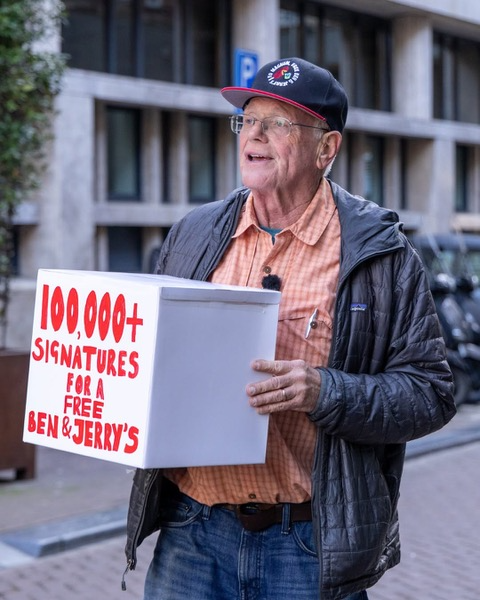
As far as co-founder Ben Cohen is concerned, separating Ben
& Jerry's Ice Cream from its social missions is as unthinkable as … carving out the cherries from the Cherry Garcia. The company has swirled purpose-driven marketing into the brand since it
launched in a converted gas station in Vermont in 1978. And while it's been a long, strange trip -- including a public offering in 1985, selling to Unilever in 2000, and a messy corporate breakup that
started over the brand's decision to stop selling ice cream in Israel because of treatment of Palestinians in Gaza in 2021 -- he's convinced the brand and its values can prevail.
Cohen takes time
from his "Free Ben & Jerry's" campaign to tell Marketing Daily why purpose-based marketing -- currently in a hostage situation in corporate America -- matters more than ever.
This interview has been edited for length and clarity.
advertisement
advertisement
Marketing Daily: First of all, how are you? You've been running this "Free Ben & Jerry's" campaign, aimed at Magnum
Ice Cream, which recently de-merged from Unilever, for months. Is the fight wearing you down?
Ben Cohen: I'm alive and licking, as we say in the ice cream business. It's definitely hard
work, and I'm anxious for us to finally win, and free Ben & Jerry's.
Marketing Daily: If I'm honest, I didn't fall in love with Ben & Jerry's because of its values. It was
Pistachio Pistachio that got me. And I've always appreciated the clever marketing -- maybe even more than that you donated to causes I believe in, like worker's rights and reproductive freedoms. Got a
trick for how you've made values so palatable?
Cohen: If the product's quality isn't there, it doesn't matter what your values are. Early on, we developed a three-part mission, with
each part written horizontally, to show they all mattered equally. We had a social mission, a product mission and a financial mission.
But values needed to come first, and that drives product.
For example, for a value-based approach to new flavors, we might find an ingredient that you can purchase in a way that has a beneficial effect on society or a particular marginalized group. That
leads to a great-tasting ice cream.
Marketing Daily: You've said that you believe either Ben & Jerry's gets sold or "Ben and Jerry's as we know it dies." Magnum tells us that Ben
& Jerry's is not for sale, and "thriving" under Magnum's ownership. Do you think you will win? What is the end game?
Cohen: I do. It's in their fiduciary interest and their
fiduciary responsibility. Right now, they're decreasing the value of this Ben & Jerry's brand, so they've essentially gotten investors to pay a premium for a very well-loved brand that is unlike
most others. And they're in the process of neutering the social mission -- that will continue to decrease the brand value. I would recommend that they sell and sell fast, before it's lower.
Marketing Daily: Got a guess on the timeline?
Cohen: I don't expect them to see problems in terms of sales in the next few months, but I think that the financial community
will understand that the current course of action is destroying the brand value. It's also a management distraction having to deal with this. They've been sued by the independent board, and now that
they cut off the funding for the Ben & Jerry's Foundation, they've been sued by the foundation.
The chair of the independent board is suing them for defamation. And we've heard that
private equity is circling Magnum. So when you ask me when they will see the light, I wouldn't be surprised if it's in the next few months.
Marketing Daily: Let's talk about Gaza,
and what happened in 2021. For almost 20 years, things seemed okay with the Unilever ownership. Was that the point where it went south?
Cohen: Correct, that was the beginning of the conflict. The independent board, management of Ben & Jerry's and Unilever all agreed
that Ben & Jerry's should pull out of the West Bank and the occupied territories, because continuing to sell ice cream there violated the values of Ben & Jerry's. I'm told the head of Israel
then called up the head of Unilever and said, "If you don't get that ice cream back here, we're going to kick all the Unilever businesses out of Israel. And so Unilever, on its own, sold off the Ben
& Jerry's rights to an Israeli company so that it would remain available. That was a violation of our acquisition agreement and created a significant problem.
Ben & Jerry's got a lot of pushback from Israelis and on social media. That’s okay. If you take a stand that
everybody already agrees with, you didn't need to take that stand in the first place.
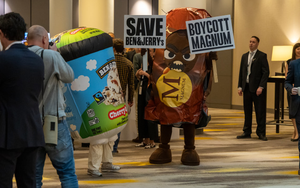
Marketing Daily: You've called for a boycott.
Cohen: Yes. When people
first heard about this, many had the first reaction to boycott Ben & Jerry's. But Ben & Jerry's is the victim here -- we want people to support them. I understand consumers want to vote with
their wallets, so I've said boycott Magnum's other brands, which include names like Breyer's, Talenti and Klondike.
Marketing Daily: When we reached out to Magnum for comment, the
company insisted it stopped funding the foundation, not out of retaliation, but because an audit revealed wrongdoing, and that the company is "firmly committed to funding a grant-giving foundation and
to supporting the Ben & Jerry's team and its three-part mission -- making great ice cream and campaigning on the causes the brand cares about."
Cohen: It was a forensic audit,
looking for dirt. And they wouldn't share the results. I believe it didn't show any unethical or illegal activities.
Marketing Daily: Many marketers, who have now spent decades
developing purpose-based marketing, are watching many of those platforms wither, given the current administration's attacks on diversity, equity and inclusion, or anything that seems even a little
"woke." Got a pep talk for those people? Is it possible for them to recover their courage and stand for something again?
Cohen: They absolutely can. You need to stand up for justice.
Corporations are incredibly powerful -- the most powerful force in our society. They need to use that power not just in their own narrow self-interest, but in the interests of the society as a whole.
Right now, we've got a president who is trampling on basic American values. Corporations need to play an active role in using their power to stand up to them.
Marketing Daily: Can you
point to other companies that are doing that?
Cohen: Tony's Chocolonely is impressive, and around $250 million in sales. Dr. Bronner's isn't just a little hippie soap company anymore.
It's a $250 million corporation.
Marketing Daily: Some might argue that if you and Jerry Greenfield were starting out today, you couldn't exist -- that America is too polarized.
Cohen: I don't agree with that at all. I was just on Church Street, the main drag in Burlington, doing some man-and-woman-on-the-street videos. We were giving them two scoops of vanilla ice
cream and telling them they could put those scoops in the human-needs bucket or the Department of War bucket. Nobody gave that second bucket any ice cream. Affordable childcare, affordable housing,
funding for education: These are things that people want.
Also, no company has 100% market share. If it's lucky, it has a few percent share. You don't have to appeal to everybody. You
just have to appeal to a slice of people, a lot. You need to create a brand that resonates really strongly with a small sliver of people because that's all you're ever going to get.
Marketing Daily: What's next for "Free Ben & Jerry's"?
Cohen: I'm going to be speaking at Ad Week New York and Brand Week Atlanta, giving marketers an opportunity to come
up with a guerrilla marketing campaign. If the campaign is successful and we free the brand, they'll win a lifetime supply of Ben & Jerry's.