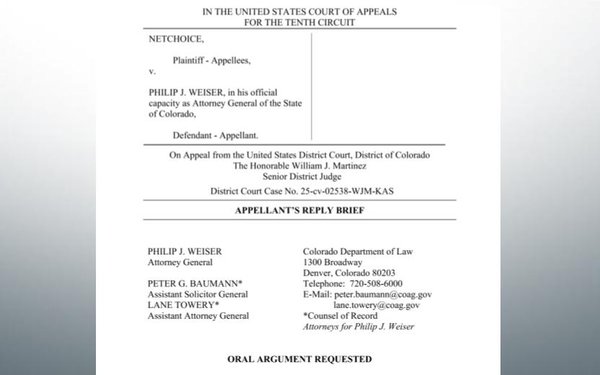
Colorado officials are urging an
appellate court to allow enforcement of a law mandating cigarette-style warnings for social media.
"Colorado’s Healthier Social Media Use by Youth Act requires social
media companies to disclose factual, research-based information to young users about the health effects of their own products," Attorney General Philip Weiser argues in papers filed recently with the
10th Circuit Court of Appeals. "Those disclosures are standard commercial product warnings."
The law (HB24-1136)
originally slated to take effect in January, requires social platforms to either provide minors with information about social media engagement that helps them "understand the impact of social media on
the developing brain and the mental and physical health of youth users," or send pop-up warnings every 30 minutes to minors who use the platforms for more than one hour a day (or between 10 p.m. and 6
a.m.).
advertisement
advertisement
Tech industry group NetChoice sued to block the measure, arguing it violates the First Amendment by forcing platforms to spread the state government's view that social
media is harmful.
Last November, U.S. District Court Judge William Martinez in Denver handed down a preliminary injunction prohibiting enforcement.
"The
Court fully appreciates Colorado’s legitimate effort to protect the children and adolescents of our state from the impacts of social media use on their health and wellbeing," Martinez wrote. "The Court concludes, however, that it is substantially likely NetChoice
will succeed on the merits of its claims that Colorado may not pursue this laudable goal by compelling social media companies to speak its expressive messages."
Weiser is now
appealing that ruling. He argues in his most recent papers, filed late last week with the 10th Circuit, that the law does not "require companies to adopt specific views or engage in
self-condemnation."
Instead, he argues, "it simply requires them to provide evidence-based information about the effects of extended use of their own apps."
NetChoice argued last month to the 10th Circuit that the mandated warnings are neither "purely factual" or "uncontroversial."
"The Act requires covered websites
to opine on social media’s impact on minors, a subject that is heavily debated in academia, the courts, and society generally," NetChoice wrote.
“'Social media' is
not a commodity like nicotine or benzene," the group added. "It is speech. And it refers to a broad collection of digital services, defined differently study-to-study, state-to-state, and
family-to-family."
Weiser counters in his new papers that the law only requires platforms to provide "research-backed information to underage users enables them to make
informed decisions about their social media use."
The battle has drawn attention from numerous outside groups.
A coalition of 43 attorneys general
backed Colorado, arguing in a friend-of-the-court brief that the warning label law aims to protect teens from mental-health harms that some researchers have linked to social media "overuse" --
including depression and suicidal thoughts.
But civil rights advocates, including the Center for Democracy & Technology, Surveillance Technology Oversight Project and LGBT
Technology Institute, argue the law should remain blocked.
Those organizations argued in their own friend-of-the-court brief that there is "dueling research" on social media's
impact on users. Citing several academic studies, the organizations say research shows "positive and negative impacts of social media use."
They added that "the mere fact of
the warning label or its frequency may itself serve to chill speech," and that young people "may not understand or may elect to ignore the research to which they are directed, and instead simply stop
using the social media platform out of annoyance or misunderstanding."
Other states including California, Minnesota and New York have laws similar to Colorado's.
NetChoice recently sued in Minnesota to block that state's statute. That mattet is currently pending in front of U.S. District Court Judge Nancy Brasel.