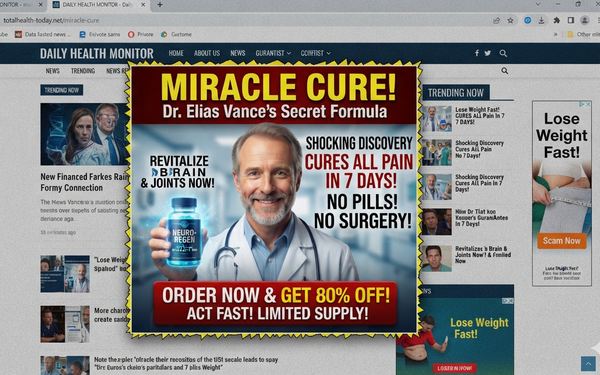
Note: the image above is an AI-generated fake medical ad,
fabricated for Pharma & Health Insider by Google’s Gemini
In mid-July,
The New York Times published a video report that “found hundreds of AI-generated
doctors, healers and wellness influencers on social media touting the health benefits of supplements to American consumers.”
For Dr. David Amron, founder of The Roxbury Institute and The
Lipedema Society, the AI fake was of himself. As he told a late-July hearing of the U.S. Senate Special Committee on Aging titled “The Ai Deception Machine,” a video showed him allegedly
endorsing a “miracle” cream for lipedema, a condition that causes abnormal fat buildup in women.
“Scammers used actual footage from my YouTube channel and combined it with
fully AI-generated likeness and voice of (a) colleague,” Dr. Amron testified, “as well as AI-generated celebrity images and stolen media logos, to create a polished advertisement that
appeared entirely legitimate.”
advertisement
advertisement
Another hearing participant, Ben Winters, director of AI and privacy for the Consumer Federation of America, cited a report from the Center for Countering
Digital Hate that found “in the past year, ads from the top 30 Medicare scammers generated 215 million impressions on Facebook, six times the reach of all previous years on record.”
Pharma & Health Insider spoke with Phyllis Marcus, vice president of the ad industry self-regulatory nonprofit the National Advertising Division (NAD) of BBB National Programs, about the
problem..
This Q&A has been edited for length and clarity.
Pharma & Health Insider: What has the NAD been doing in this area?
Phyllis Marcus: We
have been tracking this phenomenon and speaking about our observations and concerns with various media outlets.
Cases typically come to the National Advertising Division in the form of
challenges brought between competitors, but we also have a monitoring function, where we go out into the marketplace and bring cases in our own name where we see areas of concern. We have not yet
brought a case in this area, but are watching its development closely.
P&HI: Does the problem extend beyond wellness and supplements?
Marcus: I would assume it
extends to almost every corner of the influencer advertising ecosystem, but very unique issues are raised when you're talking about health and wellness products.
P&HI: What are
NAD’s specific concerns with those types of products?
Marcus: Consumers are surprised to learn, or a bit mystified, about the fact that a spokesperson or a creator might not
be an actual live person. That creates a real problem because an avatar or a virtual persona by its very nature cannot have used a product and experienced its benefits. One of the basic tenets of
influencer marketing is that an influencer should be speaking about their own experiences.
P&HI: How quickly has this problem evolved? Is it getting worse?
Marcus: We haven't been charting the trend, but everybody's talking about it now, so you can assume it is becoming more and more frequent and ubiquitous.

P&HI: What is the NAD’s role in this,
now and in the future?
Marcus: We’re getting the message out about these advertising techniques and the basic requirements of advertising law. I wouldn't be surprised if in
the future we also have cases involving the use of AI influencers.
P&HI: Can you elaborate on the advertising law involved?
Marcus: Point one: AI may
be new, but advertising principles are not. If consumers are seeing advertising, they need to clearly understand that it's advertising regardless of whether the influencer is a real person or a
virtual persona. Truth-in-advertising principles are the same regardless of the technique.
Point two: Disclosure is important and may be required by law. (For example, the state of
New York now requires disclosures when AI persona are presented to the public.) But that’s not a substitute for truthful advertising. Knowing something is AI-generated is very important, but
doesn't answer the additional question as to whether the message itself is accurate and supported. An advertiser cannot say through an influencer or a content creator what they couldn't say in their
own ad.
Point three: Advertisers have to look at the net impression of their ads. As AI influencers become more realistic, consumers may interpret synthetic personas as representing
real experiences. If you are using an AI persona, you have to think about consumer takeaways, because you’re responsible as an advertiser not just for the messages you intend to convey, but for
the messages reasonable consumers are likely to take away.
Another point: Brands need to carefully consider whether an AI-generated persona can communicate their experience without
almost automatically creating a misleading impression.
AI is a tool, not a shield. from accountability. Claims, visuals, influencer messaging, implied messages, all still have to be truthful
and supported.
P&HI: How does this affect consumer trust overall?
Marcus: Itcan shake the foundations. As seen in The New York Times video, people were
very surprised to learn that the spokesperson was not an actual person.