Seems as if every coffee shop these days also sells matcha, the green
tea made from special tea plants grown in the shade in Japan.
That was hardly so a decade ago.
You could credit much of this trend to now-84-year-old Dr. Andew Weil, the
integrative medicine pioneer and entrepreneur, who co-founded Matcha.com -- and obtained the integral URL.
Matcha.com now supplies 60% of all wholesale bulk Japanese matcha tea to
café chains across the country, Chief Brand Officer Elara Hadjipateras tells CPG Insider. The matcha is sourced via exclusive deals set up with top matcha farmers in Japan.
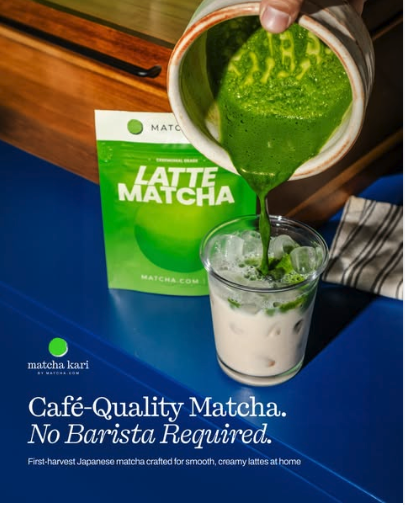
In 2016, the company also went direct-to-consumer with Matcha Kari, its branded matcha products sold only online.
Since I most often cover health-related topics, I was pitched a story on
matcha’s advantages for the gut. But it turned out that while health benefits still plays a role in the brand’s messaging, Matcha Kari’s marketing these days prefers to emphasize
Japanese culture.
advertisement
advertisement
From the start, Hadjipateras elaborates, one of Matcha Kari’s key goals has been “to take this tea culture from Japan and integrate it into people’s lives
the way coffee has been.”
One way has been the introduction of on-the-go sticks, which
Hadjipateras says has become one of Matcha Kari’s most popular items. “Do you take your coffee in the car with you on the way to dropping off your kids on the way to work?” she
asks. The on-the-go sticks take “this very traditionally Japanese drink (matcha) where you sit down to have it” and “applies it to the modern American context of being on the
go.”
One cultural emphasis, Hadjipateras adds, is “the benefit of having a ritual: whether it’s having matcha every day, taking a cold shower for 30 seconds, or making your
bed in the morning before you to go to work. It’s a healthy daily habit that exists in Japanese culture that’s being brought over.”
Matcha.com’s and Matcha
Kari’s success have wrought many competitors, leading to a saturated market in which ecommerce revenues have been slowing down, Hadjipateras reveals.
“More people have the
same-size tins at a competitive price point,” she says. “People are becoming a bit more knowledgeable as matcha drinkers. It’s not so foreign to everybody as it used to
be.”
Just like with coffee, she explains, “people are more interested in learning, ‘what’s the cultivar? What’s the region? Is it a blend?”
While
Matcha Kari’s marketing in the past has largely involved affiliate marketing and SEO (once I started researching this story, I began receiving sponsored YouTube videos, for instance), the brand
has recently began some IRL activations (just about the only place the brand is distributed outside ecommerce), including title sponsorship of MatchaFest events.
This series of events (the
next is Sept. 12 in Atlanta), Hadjipateras says, allows Matcha Kari to reach younger audiences than those usually knowledgeable about Dr. Weil (and yes, the YouTube ad targeted to me, an older guy,
featured a pitch from the icon).
Hadjipateras acknowledges that Dr. Weil tends to be “connected to a lot of the older audiences and target demos that we have,” but that Matcha Kari
now is seeking ways to “translate his knowledge and his clout to the Gen Zs” -- because for them, “it’s, ‘who is this guy?’”
One way is through
MatchaFest screenings of a new hour-long documentary starring Dr. Weil titled “Zen and the Art of Matcha” which the brand would like to place with a streaming service. Here’s a
trailer.
Dr. Weil, of course, also functions as a sort of influencer for the brand (“he was an influencer before influencers
were a thing,” says Hadjipateras).
Otherwise, though, Matcha Kari is reducing reliance on influencers.
The brand, Hadjipateras explains, is “branching away from the model
of ‘let’s pay influencers a bunch of money based on how many followers they have,’ because, at the end of the day, having a big influencer and paying them say $12,000 in a month for
one post because they have 3 million eyeballs on them does not equate to sales or the bottom line. “
Calling “the influencer setup kind of a big black hole that ‘s hard to
track,” she says that “two years ago, it was a really good model and there was a clear ROI, but in the last six to 12 months, there’s been a decline, and it’s gotten really
messy.”
As a result, she says, Matcha Kari is replacing a “piecemeal influencer story,” in which the brand would put the influencers’ post on its social platforms, with
“our matcha story via content we do ourselves in-house.”