Of all the products being
sold in B2B, one of the most complex is software, given the many platforms through which it is sold.
There is no default model. “Across the market, revenue moves through
rep-assisted sales, partner-led motions,owned digital channels, cloud marketplaces, and mobile app stores,” says a new report titled “The Cost of Selling Software,” from Cleverbridge, conducted by Ascend2.
Digital self-service is surely a cost-effective
channel and it is increasingly being used by B2B brands, but it is not yet the top one. The channels now being used include:
- Cloud
marketplace—63%
- Direct sales—61%
- Self-serve—55%
- Channel
partners—53%
- Mobile app stores—47%
advertisement
advertisement
Self-serve is hardly the first processing channel for new purchases. In this area, 42% of the transactions
are high-touch, conducted through a rep or a partner. Self-serve claims only 16%, and 42% are a mix of both.
But self-serve is important in renewals,
where it is cited by 27%, vs. 28% for high-touch and 45% for a combination of the two.
“The research reveals a significant opportunity for software sellers to offer
more self-service options, particularly for routine transactions like renewals and upgrades,” says Todd Lebo, CEO of Ascend2.
Lebo adds, “Self-service doesn’t mean less
communication; it makes timely communication even more important. Email can be the connective tissue that makes the experience work by delivering the reminders, notifications, and next steps customers
need to act without unnecessary back-and-forth.”
The purchasing processes are different on the buyer side, where a lower percentage uses self-serve. Still, it ranks only third from the
top:
- Directly with a vendor sales rep (rep-assisted)—56%
- Through an approved reseller or
distributor—36%
- Via self-serve/online checkout—22%
- Through a cloud marketplace—21%
- Through a
mobile app store—15%
- Purchases require a formal quote-to-PO/invoice process—13%
- It varies significantly be vendor, deal size, or purchase
type—8%
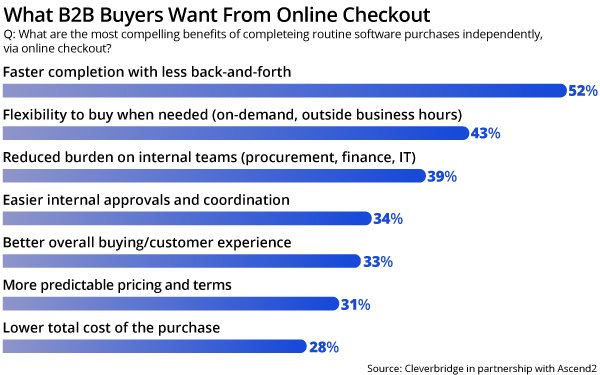
The hurdles in the process are often found on the buyer side. Of those polled, 73% say software purchases “are delayed significantly or even abandoned due to
extensive internal approvals or vendor back-and-forth. The causes span the buying process: 36% cite waiting for a quote or pricing, 30% note back-and-forth to finalize terms, and 15% point to
reseller coordination or handoffs.”
That may be why 93% of buyers would use “self-serve digital checkout for routine software purchases” if offered the option,
and it is allowed by company policy.
There are challenges on the seller side, too, one being time: “More than one-third of sellers spend six hours or more on a typical
routine transaction, and 13% spend11 hours or more,” the study notes. “Complex transactions require more time overall, but routine transactions still consume meaningful internal
capacity—especially when they compound across renewals, expansions, upgrades, and smaller new purchases.”
So there is a strong argument for self-serve,
especially give the possible costs of the other channels, like these:
- Rep-assisted motion—variable sales compensation.
- Partner-led
motion—reseller margin or commission.
- Marketplace transaction—a platform take rate.
The
takeaway?
“For software leaders, the goals are practical: understand what each buying path costs, where time and margin are under pressure, and where
transactions could move more efficiently,” the study says.
Cleverbridge partnered with Ascend2 Research to survey 608 sellers and 551 buyers across the B2B software/SaaS
market in the United States, Canada, the United Kingdom, Germany, India and Australia.
Sales-side respondents were manager-level or above at $1
million+ companies. They included executive leadership, finance, sales, operations, RevOps, marketing, and partnership/channel management.
The buyer respondents were
manager-level or above professionals involved in evaluating, approving, purchasing, renewing, or expanding software products within the last 12 months.