Marketers craving job security likely won’t get much comfort from a new
study of CMO tenure. While the most recent data suggests slight improvements, people are still spending significantly less time in the role than a decade ago.
The study also found that so far
this year, the number of Asian, Black and Latino CMOs who began their jobs declined to 16% of the total, after ranging from 19% to 22% between 2020 and 2025, a drop that predictably coincides with the
widespread corporate retreat from DEI.
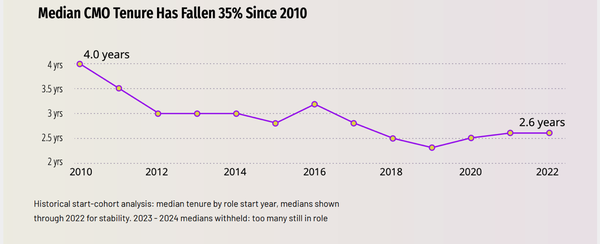
Research from CMO Huddles and Findem analyzed CMO tenure in two ways, combining historical start-cohort data. CMOs who started in 2010 had a median
tenure of 4 years. Tenure bottomed out around 2.3 years for CMOs who started in 2019 and has risen slightly: Those who started in 2022 lasted about 2.6 years.
That means median CMO tenure has
fallen 35% since the 2010 start cohort, despite small gains in the last few years. (The study tracks tenure only through the 2022 cohort, since too many later hires are still in the job to
measure.)
advertisement
advertisement
It combined those findings with an analysis of current CMOs, based on 13,000 people at U.S. companies with 100 or more employees. CMOs in that group have held their jobs a median of
3.0 years. That compares with 51 months for CEOs. A third of the CMOs have held that title for five years or more, while 30% have been in the job under 18 months.
The study underscores the
importance of ownership. Those working for public companies have an average tenure of 4 years, versus 3.1 for those at private equity-owned companies, and 2.6 for VC-backed businesses.
Fractional and interim CMO appointments, which rose sharply after 2020, remain elevated, accounting for about 8% of this year’s hires, compared to about 3% in 2020.
“The CMO role has become the pressure cooker of the C-suite,” said Drew Neisser, CEO of CMO Huddles, in the report. “Companies want marketing leaders to fix growth, reposition the
business, build demand, sharpen the brand, align sales, and prove impact fast. But the data is screaming that too many CMOs are being handed transformation-sized mandates on trial-period timelines.
That is not just hard on CMOs. It is expensive and self-defeating for companies.”
The new data both squares with and differs from the latest report from Spencer Stuart, the search
company that has tracked CMOs for the last 20 years, concentrating on those within S&P 500 companies.
It found that the average tenure among CMOs is 4.1 years, lower than the 5-year
average for all C-suite roles. That didn’t signal a revolving door, it found, but a gateway to bigger jobs: Of the 218 CMO exits it tracked between 2021 and 2025, 62% either got promoted at
their company or moved on to a similar or bigger role.
CMO tenure at consumer companies was the shortest, at 3.5 years, followed by healthcare at 3.9 years.
Spencer Stuart also
confirmed underrepresentation, with just 9% of CMOs from historically underrepresented ethnic or racial groups, compared to 12% for other C-suite roles.
One sharp difference in the studies:
While 62% of the current CMOs in Spencer Stuart’s data set were appointed from within, the CMO Huddles X Findem study notes that just 19% of the CMOs appointed so far this year were internal
hires.