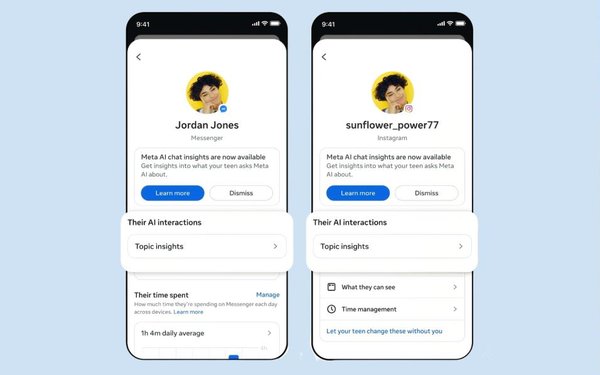
As Meta expands its consumer-facing AI
products, the tech giant is bringing global parental supervision capabilities to its Meta AI app, placing parents and guardians in charge of monitoring and restricting their teens’ in-app
activity.
By turning on the supervision setting, “parents and guardians will be able to see the topics their
teen has been asking about over the past seven days, but not the conversations themselves,” the company’s statement explains.
“Parents who want a more restrictive AI experience for their teen can also switch from the default 13+ setting to the Limited Content setting, which further limits
the kinds of conversations their teen can have in the Meta AI app,” the statement continues.
advertisement
advertisement
Meta AI
is currently the company’s most advanced consumer-facing personal AI assistant open to younger users.
By expanding initial efforts announced in April, Meta is attempting to help
parents understand what their teens are asking and searching for on the app.
Notably, Meta has recently been found to have violated teens’ safety and mental
health, fined $567 million in August for allegedly
contributing to a “youth mental health crisis,” according to a New Mexico judge who found that Facebook and Instagram were both designed to maximize the amount of time that underage users
spend on the platforms.
While social media platforms like Facebook and Instagram have been around for years, personal AI assistants like Meta AI are
relatively new, presenting consumers and regulators with the potential for unseen risks.
Studies have shown that AI companions could have harmful effects on the population, leading to
“users’ over-reliance and susceptibility to manipulation from the chat,” as well as the development of “shame from stigma,” “risk of personal data misuse, erosion
of human relationships,” “early exposure to sexual content,” the perpetuation of loneliness, and other long-term
concerns.
In addition, more teenagers are using AI companions than ever before. According to Pew Research,
57% of U.S. teens have used chatbots to search for information, and 54% have used AI to
help them with their schoolwork.
Earlier this summer, a Meta spokesperson said that the company has
“worked with parents and experts to understand which AI conversations warrant an alert -- such as those where a teen makes a clear reference to hurting themselves, even if that reference is
subtle.”
However, some experts believe that Meta’s parental supervision tools and alert systems put too much responsibility on teens’
guardians to ensure a safe experience using AI.
When Meta initially announced its Meta AI parental supervision tools, Executive Director of children’s
advocacy nonprofit Fairplay Josh Golin told Mashable that the company “‘once again’ burdens parents with monitoring their child's online activity in lieu of ‘building a
safe product to begin with.’”
Golin believes that regardless of parental oversight, Meta’s chatbot’s main goal remains the same:
“to manipulate young people into spending more time on the platform by encouraging teens to form unhealthy emotional connections to bots.”