Even the most isolated email
teams are hearing faint whispers about the role of influencers. Indeed, many are being called on to help drive the programs, for CEOs know that thought leadership can help their firms get onto buyer
shortlists.
There is good reason for this feeling: 93% of firms with influencer programs say they’re effective, although only 46% call
them very effective, according to a new study from TopRank Marketing and Ascend2: “The 2027 B2B Influencer And Creator Marketing Report.”
What’s more, 92% of marketers feel at least somewhat confident when arguing for higher influencer budgets.
How do they measure success? The most common
metrics are:
- Engagement—48%
- ROI—46%
- Reach/views—45%
- Revenue attribution—33%
- Pipeline influenced—25%
advertisement
advertisement
What gets reported to the C Suite is roughly in line
with this:
- Brand awareness—54%
- Engagement—47%
- Revenue
attribution—34%
- Pipeline—22%
You can see that engagement even tops ROI and other dollar-based measurements. But
even the engagement rate is relatively unimportant when evaluating creators (a word that seems to mean the same thing as “influencers”). The people who hire them want to see:
- Trustworthiness and credibility with their audience—46%
- Relevance of their audience to our target
market—40%
- Subject matter expertise and domain authority—31%
- Engagement rate—31%
- Size of
audience or network—30%
- Values alignment with our brand—29%
What role does email play?
Established companies have integrated their email, paid media and events. But best-in-class marketers have gone beyond that to include feeds, ABM, sales, SEO and AI search.
And email
supports other critical activities. “B2B influencer marketing isn't just about social media anymore,” says Todd Lebo, CEO of Ascend2. “Email lets you bring trusted industry voices
directly to engaged audiences.”
Lebo continues that the Ascend2 and TopRank Marketing research found that “38% of the most effective B2B influencer programs invest in
newsletters, compared to 25% of other programs. For email marketers, the opportunity is to move beyond promotional messages and incorporate credible experts, original insights, and content that builds
trust throughout the buying journey.”
Aside from newsletters, other popular content formats are podcasts (37% of firms have very effective programs) and research
reports (35%).
All this is line with a shift in buyer search behavior. The study cites third-party industry research showing that:
- 51% of buyers are
starting their research with an AI chatbot more than Google.
- 43.% of B2B firms appear in early-stage questions inside AI environments (That's where you want
to be).
- 89% of citations for unbranded prompts appear from third-party sources, and not from brand-owned content.
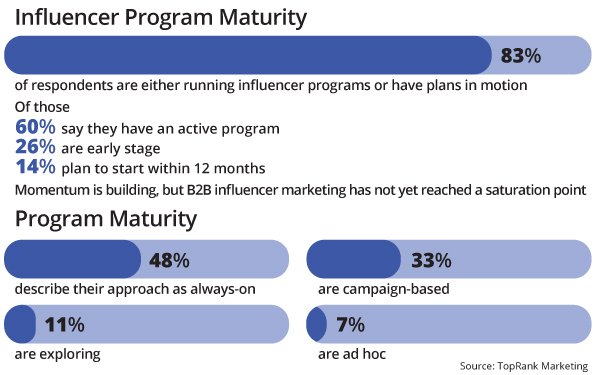
- The respondents agree that always
on influencer programs work better than campaigns. And it pays to have full documentation of everything. Here's how leading B2B brand marketers describe their influencer work:
- Strategy is fully documented—73%
- Uses on always-on strategy—72%
- Integrates with paid
amplification—53%
- Uses purpose-built influencer platform—52%
- Integrates with AI search
optimization—49%
- Partners with journalists as creators—34%
- Fully dedicated influencer
team—15%
TopRank Marketing partnered with research firm Ascend2. The latter surveyed 424 respondents who now run an influencer marketing
program or are building or planning one in the nexy 12 months. The survey, which was conducted from mid-May to mid-June, targeted B2B professionals in manager-level roles or above at US firms
with 100 or more employees. In addition, interviews were conducted with B2B practitioners.