Commentary

Parties Find Common Ground: News Sources They Trust Least


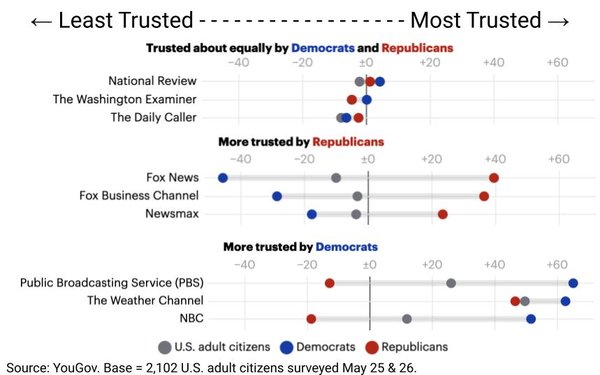
YouGov released its annual poll of the news sources American voters trust most and least and for the first time, as far as I can tell, they have a tabulation on the sources trusted "about equally" by Democrats and Republicans.

Ironically, they are all news outlets that would likely be …

2 comments about "Parties Find Common Ground: News Sources They Trust Least".
Check to receive email when comments are posted.
  1. Dan C. from MS Entertainment, June 30, 2026 at 1:46 p.m.

    Seems like a highly flawed and misleading analysis.

    The poll does not take into account the scale differences through the distortion of familiarity.  It's silly to take a broad poll where niche outlets with small audiences (The Daily Caller, National Review) are unknown to most survey respondents. This results in a high volume of "Don't Know" or neutral answers, which artificially compresses their scores close to zero (±0) and makes them falsely appear "equally trusted." Conversely, massive outlets (NBC, Fox News) are recognized by almost everyone, whether they watch or not, generating strong, polarizing reactions that pull their scores to the extreme ends of the spectrum.


    It also treats entirely different content models as identical.  The comparison forces properties with fundamentally distinct purposes into the same category. It stacks a universally utilized, non-political outlet like The Weather Channel against commercial, 24-hour cable and broadcast networks (Fox News, NBC) that mix hard news with highly polarized evening opinion blocks.


    I'd like to understand how they chose these properties and why MP, along with other outlets, constantly conflates opinion and talking heads with "news."  The Daily Wire's about section literally states that it is about "news, opinion, and entertainment...The Daily Wire does not claim to be without bias. We’re opinionated, we’re noisy...The Daily Wire was meant to be something unique in the right-of-center media landscape."


    It's like asking who do you trust to get medical advice?  Your doctor, the Mayo Clinic, Joe Rogan, or Oprah?


    It's not even close to being apples to apples.

  2. Ed Papazian from Media Dynamics Inc, June 30, 2026 at 6:39 p.m.

    Dan, I agree with you about the familiarity bias in such surveys. Also, I can't imagine what a respondent is thinking about when answering about his "degree of "trust" in the CBS or ABC TV network news?   So what does a low score for CBS among Democrats mean--a response to the recent shakeup at "60 Minutes"--maybe? But does it also apply to the network's nightly news, its early AM show, its weekend political interviews? And more to the point, does any of this affect the response to advertising on those networks? 

    The best way to go at the "trust" thing is to do it on a show by show basis--but that kind of specific questionning is impossible for the online researchers as it takes too long to execute. So, instead, we get highly impressionistic evaluations which may provide some interesting directional evidence--but little more. 

Next story loading loading..

Discover Our Publications